linux
open source
Technology
9M2PJU, Cloudflare WAF, CVE-2026-109618, CVE-2026-109619, Heartbleed, Huntress, Log4Shell, memory disclosure, mod_php, open source security, PHP security, PHP-FPM, PHP2Shell, remote code execution, Sansec, server hardening, use-after-free, web application firewall, Wiz Research, WordPress security
9M2PJU
0 Comments
PHP2Shell: Critical PHP RCE Flaws CVE-2026-109618 and CVE-2026-109619 plus Cloudflare WAF Protection
TL;DR: Quick Summary
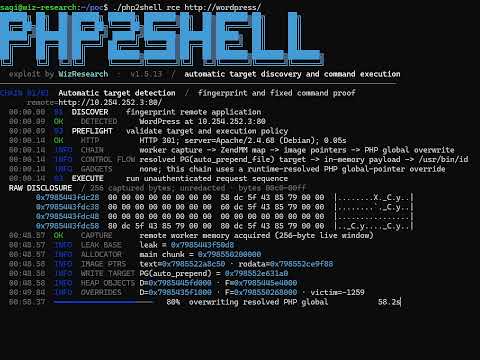
PHP2Shell is the name for two critical memory safety flaws in the PHP engine core, tracked as CVE-2026-109618 and CVE-2026-109619 with CVSS v4.0 score 9.2. Both allow unauthenticated remote code execution and remote memory disclosure against any PHP web application, including WordPress, Drupal, Joomla, Magento, MediaWiki, Nextcloud, Laravel, and even a plain Hello World script. Every PHP version from 5.4 (released in 2012) through the October 2026 releases is affected. Fixed versions are PHP 8.5.12, 8.4.27, 8.3.36, and 8.2.35, released on 21 October 2026. PHP 8.1 and older get no official fix. Cloudflare deployed managed WAF and new full transaction response rules about 9 hours before public disclosure, enabled by default on all plans including Free. Patch PHP immediately, keep the WAF enabled, inventory every PHP install, block suspicious multipart uploads as a temporary measure, and watch for PHP workers spawning shells.
What Is PHP2Shell?
PHP2Shell is a pair of unauthenticated remote code execution vulnerabilities in the PHP language runtime itself that let a remote attacker run code as the web worker account or read live worker memory with passwords and tokens by sending crafted HTTP requests, with no login and no flaw in the hosted application required.
That definition matters because most site owners think in application terms: update WordPress, update plugins, update the theme. PHP2Shell sits one layer below all of that. The vulnerable code is the C code of the PHP interpreter that parses HTTP requests, manages request memory, and cleans up after fatal errors. If the interpreter is vulnerable, WordPress 7.1.2, Drupal 11.4.3, Joomla 6.1.4, Magento 2.4.9, MediaWiki 1.46.2, Roundcube 1.7.4, phpMyAdmin 5.2.3, Nextcloud 35.0.1, Laravel 13.11, Symfony 8.1, and WHMCS are all exposed even when their own PHP code is fully patched. Researchers confirmed pre-authentication RCE against stock Docker images of WordPress, Drupal, and Joomla, plus Magento and ten other stacks. A minimal test script that prints phpinfo is enough to prove exposure if it runs on a vulnerable PHP build.
At a Glance: The Two CVEs
| Item | CVE-2026-109618 | CVE-2026-109619 |
|---|---|---|
| Nickname | Upload progress unserializer use after free, plus remote memory disclosure | Fatal error backtrace use after free, plus OPcache type confusion |
| CVSS v4.0 | 9.2 Critical | 9.2 Critical |
| Attacker login needed | No, unauthenticated over HTTP | No, unauthenticated over HTTP |
| Impact shown | RCE on WordPress, Drupal, Joomla; application agnostic memory disclosure | RCE on Drupal and WordPress via separate primitives |
| Root pattern | Out of memory error interrupts request setup, partially initialized data later treated as valid | Fatal error leaves request state pointing at freed memory, later request reuses the stale pointer |
| Leaks secrets | Yes, freed worker heap returned inside a PHPSESSID response cookie | Yes, heap use after free can disclose memory |
| Needs app session code | No, works even when the app never calls session_start | Depends on diagnostic or OPcache path, still pre-auth |
| Fixed in | PHP 8.5.12, 8.4.27, 8.3.36, 8.2.35 | PHP 8.5.12, 8.4.27, 8.3.36, 8.2.35 |
A Short History: From Heartbleed to PHP2Shell
Server side memory bugs keep returning because the internet runs on a small set of shared C codebases. Three earlier incidents explain why PHP2Shell got a name and a logo.
1. Heartbleed in OpenSSL (2014)
Heartbleed (CVE-2014-0160) let anyone read 64 KB chunks of server memory through a missing bounds check in the TLS heartbeat extension. Passwords, cookies, and private keys leaked with no trace in normal logs. PHP2Shell revives the same fear: CVE-2026-109618 returns attacker sized regions of live PHP worker memory inside a normal looking Set-Cookie response, similar in spirit to Heartbleed but through PHP request cleanup instead of TLS.
2. Shellshock in Bash (2014) and Log4Shell in Log4j (2021)
Shellshock showed that a parser far below the application (environment variable parsing in Bash) could give remote shells across DHCP, CGI, and SSH vectors. Log4Shell showed that one logging library buried in thousands of Java products could force the whole industry to hunt for every bundled copy. PHP2Shell combines both lessons. The parser is PHP request startup code that runs before any application check such as WordPress maintenance mode, and PHP itself is buried inside shared hosting panels, vendor appliances, Docker images, NAS boxes, and control panels like cPanel and Plesk that owners forget contain php.exe or php-cgi.
3. Why the flaws hid for over a decade
The vulnerable request lifecycle code dates to PHP 5.4.0 from 2012. Turning a crash into reliable RCE required chaining several bugs and adapting to each target memory layout, PHP version, SAPI, and CMS. Wiz Research states that frontier AI models made that manual grind practical: Wiz Atlas plus Gemini 4 Argon and GPT-5.6 Sol helped find the flaws, adapt exploits across WordPress, Drupal, and Joomla in hours, build detections, and verify the vendor patch. Calif researcher Ryan Austin independently found multiple RCE paths, and OpenAI contributed to discovery and patch verification. The economics changed. Complexity alone no longer protects old code.
Timeline of Disclosure
| Date in 2026 | Event |
|---|---|
| 1 Aug | Calif finds multiple PHP RCE paths |
| 11 Aug | Calif reports the first bug to PHP, coordinated disclosure starts |
| 19 Aug | Wiz Research discovers the first flaw with Atlas, Gemini 4 Argon, GPT-5.6 Sol |
| 20 to 21 Aug | Wiz confirms unauthenticated RCE against Drupal, then WordPress |
| 24 Aug | Wiz reports to the PHP security team |
| 21 Sep | PHP acknowledges reports and starts a coordinated fix |
| 20 Oct morning | Leak: Hacker News post claims two critical PHP RCEs, post removed, screenshots spread, watchTowr confirms the leak is real |
| 20 Oct | PHP posts advance notice, emergency release set for 21 Oct 14:00 UTC, warns it may ship earlier if details go public |
| 21 Oct 03:02 UTC | Cloudflare managed WAF protection goes live by default on all plans, about 9 hours before disclosure |
| 21 Oct 07:43 UTC | Cloudflare reports early attack traffic in the wild |
| 21 Oct around 13:30 to 14:00 UTC (9:30 am ET) | PHP releases fixed versions 8.5.12, 8.4.27, 8.3.36, 8.2.35; Calif, Wiz, OpenAI, and PHP Foundation publish writeups |
| 21 Oct onward | Public exploit tool PHP2Shell circulates, mass scanning expected, WAF analysts tune rules |
Technical Deep Dive: How PHP2Shell Works
All four reported primitives share one theme: a fatal error during a request, most often out of memory when crossing memory_limit, interrupts native C code before cleanup finishes. The request heap is destroyed but some global pointer still points at the freed block. A later request handled by the same worker trusts the stale pointer before normal initialization resets it.
Affected SAPIs include PHP-FPM, Apache mod_php with prefork workers, php-cgi, FrankenPHP, and LiteSpeed. Default configurations are vulnerable. Application logs may show little because the exploit runs below application code.
CVE-2026-109618: Upload Progress Unserializer and Memory Disclosure
PHP parses RFC1867 multipart/form-data bodies during request startup, before normal module initialization. The session upload progress handler can initialize session state at this early stage and publish a session ID in the PS(id) global. If an out of memory error aborts the request, PHP destroys the request heap but may leave PS(id) pointing at the freed allocation.
On a later multipart request handled by the same worker, the upload progress cleanup path runs before normal session init resets the pointer. PHP trusts the stale pointer and length as a live zend_string and URL encodes reclaimed heap bytes into a PHPSESSID response cookie. That’s the Heartbleed style leak. It works even when the application never calls session_start, so no WordPress or plugin setting can switch it off.
The same family includes an upload progress unserializer use after free. Decoder bookkeeping lives in BG(unserialize). A fatal allocation failure interrupts the path, destroys the heap, and leaves the global unserializer state published. A later request reclaims that memory with attacker controlled bytes and PHP treats it as live decoder state, which gives a strong memory corruption primitive. Wiz combined disclosure plus corruption to remove address uncertainty and reach RCE on WordPress, Drupal, and Joomla.
CVE-2026-109619: Fatal Backtrace and OPcache Type Confusion
Two related primitives share this CVE number.
First, PHP keeps the backtrace of the most recent fatal error in EG(last_fatal_error_backtrace). A fatal out of memory error can destroy the request heap without undefining that executor global. The worker survives with a dangling pointer. If the same worker emits a diagnostic early in the next request, it touches the pointer before the executor reinitializes the state, then destroys or updates the dangling backtrace and follows attacker reclaimed memory.
Second, OPcache persists compiled structures in shared memory and assigns indices into per worker runtime pointer maps. Workers coordinate through a shared frontier. During zend_accel_script_persist, PHP advances the process local CG(map_ptr_last) frontier and only later publishes the shared frontier. An allocation failure between those two steps leaves the local advance in place with partially persisted objects pointing at slots the shared state still considers free. When another worker later reuses a slot for a different runtime object, stale shared metadata resolves to the wrong type. That cross worker type confusion corrupts shared OPcache state. Wiz used it for unauthenticated RCE against WordPress.
PHP notes there are other tracked and likely untracked variants of the same root pattern. The official patch fixes the core lifecycle instead of blocking single payloads, which is why updating PHP is the only complete remediation.
Cloudflare WAF Protection: What the 21 October Blog Post Announced
Cloudflare published Cloudflare deploys protections against php2shell vulnerability on 21 October 2026. The post is worth reading in full because it documents a new WAF capability, not just new signatures.
Key points from the Cloudflare announcement:
- Protection went live at 21 October 03:02 UTC by default for customers using the managed WAF, on Free and paid plans. No action was needed to get initial coverage.
- Cloudflare joined a coordinated effort with the PHP Foundation, OpenAI, Wiz, Automattic, Akamai, AWS, Fastly, Google, Imperva, Microsoft, Vercel, and others. Rules were developed and deployed since early October 2026.
- Early exploit traffic was already observed before the official 14:00 UTC release because details leaked on 20 October. Attackers mutated payloads to try bypasses. Cloudflare tracked match volume and cross checked it against rule logic.
- Request only rules weren’t enough. Request data alone often can’t separate an exploit from legitimate traffic with confidence. The origin response adds context that shows whether an exploit succeeded, which reduces false positives.
- The answer is full transaction detection, a new Cloudflare WAF capability that combines signals from the request and the response inside the same HTTP transaction. A matching full transaction rule can block the origin response before it reaches the requester. PHP2Shell is the first managed detection released with this capability.
- Customers should still patch PHP. WAF is defense in depth. Analysts continue to monitor and update rules as new techniques appear. Track the WAF changelog.
Cloudflare Rule Tables Published in the Post
Free plan, Cloudflare Managed Free Ruleset (ruleset ID 77454fe2d30c4220b5701f6fdfb893ba):
| Rule description | Rule ID |
|---|---|
| Generic Rules – Anomalous Execution – 1 | 4e315666e8e344cdb64139a3b5ccf32f |
| Generic Rules – Anomalous Execution – 2 | 00c10e6cc4da4bb08722adeebcd95984 |
| Generic Rules – Anomalous Execution – 3 | 48ddf592361e4fb97a8a59abe2d613fa |
| Generic Rules – Anomalous Execution – 4 | 3556683d512a47f293789c524b1ac4c6 |
| Generic Rules – Anomalous Execution – 5 | da07c85852e34625b48cef6ede46c |
| Generic Rules – Anomalous Execution – 6 | 19373a83abb840e18ab3ce5a7975ce1b |
| Generic Rules – Anomalous Execution – 7 | 07f0b6ddaabf40b1b2042dade8d6f413 |
Paid plans (Pro, Business, Enterprise), Cloudflare Managed Ruleset (ruleset ID efb7b8c949ac4650a09736fc376e9aee), review deployment in block mode:
| Rule description | Rule ID |
|---|---|
| Generic Rules – Anomalous Execution – 1 | c1d409ad838f47f54438d2cf438d5dd |
| Generic Rules – Anomalous Execution – 2 | f9a45927414245c3ad0f24e1a0c2f64 |
| Generic Rules – Anomalous Execution – 3 | 771c654ad1e4f5da7482f4e1545d3c4 |
| Generic Rules – Anomalous Execution – 4 | 217005865f0145f392300bac212afcc95 |
| Generic Rules – Anomalous Execution – 5 | 38ef82e7ea594e17bd67c376e9aee2b |
| Generic Rules – Anomalous Execution – 6 | 4148ae686dfbdb0487fab9f3cdb9a073 |
| Generic Rules – Anomalous Execution – 7 | 1389aa25961743781ccf149c48144635 |
New Cloudflare Managed Response Firewall Default for all plans including Free:
| Rule description | Rule ID |
|---|---|
| Default block for High confidence Signatures | afffe22785674c80a31875c848d2242a |
Cloudflare notes the response rule descriptions will be updated soon. To review blocks, open Security, Security Analytics, Events in the dashboard, filter by the rule IDs above, and inspect matched request, action, and path. Scope the Managed Ruleset to relevant application paths if tuning is needed, following the deploy the Managed Ruleset guide.
Why Full Transaction Detection Matters for Site Owners
Traditional WAF rules only see the inbound request. PHP2Shell payloads abuse normal looking multipart uploads and memory pressure, which shared hosting panels, WordPress media uploads, and contact forms generate all day. Blocking on request shape alone would either miss variants or break uploads.
By also scoring response signals (anomalous execution markers, leaked worker memory patterns, high confidence exploit success indicators), Cloudflare can block the origin response before it reaches the attacker while letting normal uploads pass. For a ham running a WordPress blog, a DX cluster web view, or a club logbook behind Cloudflare, that means Free plan protection without writing custom rules, as long as the managed ruleset stays enabled and in block or managed challenge mode.
Are You Affected? Check These Cases
- Any internet facing server running PHP 5.4 or later for web requests is in scope until patched, including PHP-FPM with nginx or Apache event MPM, Apache mod_php prefork, php-cgi, FrankenPHP, and LiteSpeed.
- Patch coverage stops at PHP 8.2. Supported fixed releases are 8.5.12, 8.4.27, 8.3.36, and 8.2.35. PHP 8.1 and older, including the still common 7.4 and 8.0 and 8.1 builds, get no official update. Some Linux distributions and LTS vendors backport fixes, and PHP published minimal source backports for 7.4, 8.0, and 8.1 for operators who build from source. If your host can’t backport, plan an upgrade to 8.2 or newer.
- Remi repository users on RHEL family systems should note the PHP Foundation warning that updated rpms.remirepo.net packages weren’t available on release day. Switch to distribution packages or build from source if the maintainer repo lags.
- Hidden PHP counts. Inventory web servers first, then hunt for bundled PHP in vendor appliances, Windows tools shipping php.exe or php-cgi.exe, NAS apps, Docker images tagged wordpress:latest or drupal:latest or joomla:latest from before the fix, and anything running WordPress, Drupal, Joomla, Magento, MediaWiki, Roundcube, phpMyAdmin, Nextcloud, or WHMCS.
- Shared hosting customers should ask the provider for the exact PHP build date and whether the 21 October security release or a backport is installed. A control panel PHP version selector isn’t proof until the provider confirms the underlying binary is patched.
What To Do Now: Patch First, Mitigate Second
1. Update PHP immediately
- Update internet facing systems first to 8.5.12, 8.4.27, 8.3.36, or 8.2.35 from php.net downloads. Check your Linux distribution or LTS vendor for updated packages, since many received patches ahead of publication.
- Restart PHP-FPM pools, Apache, or the container after updating, then verify with a phpinfo page or php -v on the exact SAPI that serves web traffic, not just the CLI binary.
- Keep Cloudflare managed WAF enabled while patching. WAF plus fast patching is the combination Cloudflare, PHP, Wiz, and Sansec all recommend.
- Schedule upgrades for EOL branches. PHP 8.1 gets no official fix, only a source backport branch. Treat 8.1, 8.0, 7.4, 7.x, and 5.x as guilty until reinstalled on a supported branch.
2. Temporary mitigations if you cannot patch within the hour
These are partial and buy time only. They don’t replace the PHP update. Sansec and PHP stress this point because several large Dutch sites briefly went offline as a precaution on release day.
- Block multipart/form-data at the web server. Every known trigger is a multipart request, the format browsers use for file uploads. PHP parses that body before application code runs.
For nginx, inside every server block that passes to PHP:
if ($http_content_type ~* "multipart/form-data") {
    return 403;
}
Then run nginx -t and reload.
For Apache, inside every VirtualHost that serves PHP:
RewriteEngine On
RewriteCond %{HTTP:Content-Type} multipart/form-data [NC]
RewriteRule ^ - [F]
Then reload Apache. This breaks file uploads such as product images in Magento admin or media uploads in WordPress. Some cart and checkout forms also submit as multipart, so place a test order. Remove the rule after updating PHP.
- Go offline or read only if the risk justifies it. PHP core developer Gina Peter Banyard called taking the server offline the most sensible option before the patch. Stop PHP-FPM and serve a static maintenance page. Note that Magento and WordPress maintenance modes don’t help, because PHP parses each request before the application checks the maintenance flag. If full offline is too much, have the web server reject every method except GET and HEAD so visitors can read but can’t log in or order:
if ($request_method !~ ^(GET|HEAD)$) {
    return 503;
}
- Adjust PHP settings with care. PHP advisories mention turning off session upload progress and removing the memory cap as exposure reducers:
session.upload_progress.enabled = 0
memory_limit = -1
With mod_php set them in php.ini or a conf.d drop in and restart Apache. With PHP-FPM set them per pool, for example in /etc/php/8.3/fpm/pool.d/www.conf:
php_admin_flag[session.upload_progress.enabled] = off
php_admin_value[memory_limit] = -1
Reload the FPM workers and confirm values in a page served by PHP-FPM, not on the CLI. Banyard warned that disabling upload progress alone isn’t enough, and memory_limit -1 lets one request consume all server memory. Combine these with the web server blocks above, watch memory use, and restore normal limits after patching.
- Restrict uploads and limit sizes even after basic mitigation. Smaller post_max_size and upload_max_filesize plus strict WAF upload rules reduce memory pressure paths but don’t fix the engine.
3. Detect and hunt for exploitation
- Watch for unusual multipart POST bursts followed by HTTP 500 responses, memory limit errors, or PHP worker churn.
- Alert on PHP workers spawning shells or tools: sh, bash, cmd.exe, powershell.exe, python, perl, curl, wget, nc, certutil.exe, plus reverse shell strings such as /dev/tcp/, fsockopen, mkfifo, and quick recon commands such as whoami, id, uname -a, or ipconfig from a web worker parent like php-fpm, php-cgi, httpd, or apache2.
- On Linux servers without endpoint detection, Florian Roth published a free process-watcher config for this incident with an observe mode quick start.
- If you find a hit, isolate the server, preserve web and PHP logs, and hunt for webshells and new files in the web root, new cron jobs, scheduled tasks, and new accounts. Assume leaked worker memory may contain session tokens, API keys, and certificates, so rotate secrets after rebuilding on fixed PHP.
Comparison: PHP2Shell Against Other Internet Scale Flaws
| Flaw | Year | Layer | Transport | Secret leak | RCE | Fix posture |
|---|---|---|---|---|---|---|
| Heartbleed CVE-2014-0160 | 2014 | OpenSSL heartbeat | TLS heartbeat request | Yes, 64 KB per heartbeat | No direct RCE | Update OpenSSL, revoke certs |
| Shellshock CVE-2014-6271 | 2014 | Bash env parsing | CGI, DHCP, SSH env | Limited | Yes, command run | Update Bash, block env vectors |
| Log4Shell CVE-2021-44228 | 2021 | Log4j JNDI lookup | Log strings | Sometimes via exfil | Yes, remote class load | Update Log4j, remove JndiLookup |
| PHP2Shell CVE-2026-109618 | 2026 | PHP request lifecycle | Multipart HTTP POST | Yes, worker heap in cookie | Yes, pre-auth | Update PHP engine, WAF response rules |
| PHP2Shell CVE-2026-109619 | 2026 | PHP fatal error plus OPcache | Later HTTP request on same worker | Yes, heap disclosure | Yes, pre-auth | Update PHP engine, WAF response rules |
The practical takeaway repeats across all five rows. Shared runtime code means one fix location but thousands of discovery locations. Inventory matters as much as patching.
Practical Example: Hardening a Live WordPress Site on Old PHP
Many ham radio sites, including WordPress blogs that host logbooks, cluster maps, and firmware download pages, run on shared FreeBSD or Linux hosts where the PHP version is controlled by the hosting admin, not the site owner. A common real case in October 2026 is WordPress running on PHP 8.1.29, which is end of life for official PHP updates and therefore has no 8.1 fix for PHP2Shell, only a source backport branch.
If you are in that position, the playbook used on production WordPress estates was:
- Confirm the exact build through the edge to the origin: check response headers, a phpinfo probe file removed right after use, and the FPM pool that actually serves the vhost.
- Ask the host admin to rebuild with the backport branch or upgrade to 8.2.35 or newer with extension parity checked.
- While waiting, keep Cloudflare managed WAF enabled and add a narrow virtual patch at the edge: challenge or block anonymous multipart POSTs and very large anonymous POST bodies, while logged in authors and normal GET traffic pass through. One tested pattern blocks anonymous requests that are multipart or declare Content-Length of 1 MB and above, which shrinks both the upload progress path and the out of memory path without breaking media uploads for authors.
- Remember limits: chunked POSTs without Content-Length bypass size checks, so only a PHP update is a complete fix. Monitor managed rule hits, keep backups verified, and recheck the PHP version after the host confirms the rebuild.
Limitations and Honest Notes
- Cloudflare WAF helps but can’t see inside encrypted origin responses it doesn’t terminate, and can’t fix leaked secrets already exposed before rules went live at 03:02 UTC. Rotate keys if exposure is plausible.
- Multipart blocks break legitimate uploads. Document the exception window, tell editors and store managers, and remove the block after patching.
- Memory_limit -1 is risky on small VPS and Pi hosts common in ham shacks. One large request can trigger the OOM killer and take down Dire Wolf, DX cluster clients, or logging stacks sharing the box.
- Third party patches floating on GitHub for EOL PHP may help builders from source, but Huntress and others note they can’t vouch for every fork. Prefer distribution packages, LTS vendor backports, or official source builds, tested on a staging copy first.
- AI generated exploit tooling cuts both ways. Defenders can now reproduce and validate faster too, which is why coordinated disclosure included Cloudflare, AWS, Google, Fastly, Akamai, Imperva, Microsoft, and Vercel mitigations alongside the PHP release.
Frequently Asked Questions
What is PHP2Shell in one sentence?
PHP2Shell is a pair of critical unauthenticated PHP engine flaws, CVE-2026-109618 and CVE-2026-109619, allowing remote code execution and worker memory disclosure through crafted HTTP requests.
Which PHP versions fix PHP2Shell?
Fixed releases are PHP 8.5.12, 8.4.27, 8.3.36, and 8.2.35 from 21 October 2026. PHP 8.1 and older have no official fix.
Does Cloudflare block PHP2Shell on the Free plan?
Yes. Cloudflare enabled managed request rules plus new full transaction response rules by default on all plans including Free from 03:02 UTC on 21 October 2026.
Can a plugin or WordPress update fix PHP2Shell?
No. The flaws are in the PHP interpreter below the application. You must update PHP itself and keep WAF protection enabled.
What should I do if my host still runs PHP 8.1?
Ask for a backport rebuild or upgrade to 8.2.35 or newer. Until then, isolate the host, block anonymous multipart uploads at the edge, limit POST sizes, and monitor PHP workers.
Sources and Further Reading
- Cloudflare Blog: Cloudflare deploys protections against php2shell vulnerability – managed rulesets, rule IDs, and full transaction detection
- Cloudflare Blog: Full transaction WAF capability – how request plus response detection works
- Wiz Research: PHP2Shell: AI uncovers critical RCE vulnerabilities affecting 70 percent of the Internet – discovery with Atlas, Gemini 4 Argon, GPT-5.6 Sol and technical deep dive
- Sansec Forensics: PHP2Shell: Critical PHP RCE CVE-2026-109618, CVE-2026-109619 – Magento and store focused mitigations including nginx and Apache blocks
- Huntress: Rapid Response: php2shell, Leaked Critical PHP Vulnerabilities – timeline, affected SAPIs, fixed versions, and hunting guidance
- PHP Foundation: Today PHP security release and strengthening PHP security – vendor release context
- PHP Advisory: PHP archive 21 October 2026 release – fixed versions and upgrade guidance
- OpenAI: Coordinated disclosure of critical vulnerabilities – disclosure coordination notes
- WatchTowr: PHP Remote Code Execution FAQ CVE-2026-109618 – early leak confirmation and FAQ
- Florian Roth process-watcher: PHP RCE October 2026 quick start – free Linux child process monitoring
73 de 9M2PJU

Post Comment