TA-APRS: Modern Windows APRS Digipeater and iGate with Soundcard AFSK and DTMF Remote Control
TL;DR: TA-APRS is a modern, Windows-native APRS digipeater and iGate software suite developed by Turkish radio amateurs TA2AEC (Erdem Cengiz) and TA3JO (Abidin Çakır). It integrates an internal 1200 baud Bell 202 AFSK soundcard modem, COM port RTS/DTR PTT switching, over-the-air DTMF remote control, WIDEn-N packet repeating, APRS-IS internet gating, and visual packet counters into a single standalone application. Currently undergoing on-air field testing in version 2.4.0, TA-APRS removes the need for complex Linux terminal setups, third-party soundcard bridges, and legacy 16-bit software for Windows-based ham shacks and repeater sites.
What is TA-APRS?
TA-APRS is a native Windows software application that combines an APRS packet digipeater, an APRS-IS internet gateway, an audio soundcard modem, and an over-the-air DTMF remote control system into a unified graphical interface.
+-------------------------------------------------------------------------+
|                               TA-APRS                                   |
|                                                                         |
|  +--------------------+   +---------------------+   +----------------+  |
|  | Windows Audio I/O  |   | Serial COM Port     |   | APRS-IS Client |  |
|  | (1200 Baud AFSK)   |   | (RTS / DTR PTT)     |   | (Tier 2 Net)   |  |
|  +---------+----------+   +----------+----------+   +--------+-------+  |
|            |                         |                       |          |
|            +-------------------------+-----------------------+          |
|                                      |                                  |
|            +-------------------------v-----------------------+          |
|            |         Packet Engine & Deduplication           |          |
|            |   (WIDEn-N / Fill-in / Digipeat / Filters)      |          |
|            +-------------------------+-----------------------+          |
|                                      |                                  |
|            +-------------------------v-----------------------+          |
|            |        DTMF Remote Telemetry & Watchdog         |          |
|            +-------------------------------------------------+          |
+-------------------------------------------------------------------------+
                                       |
                   +-------------------+-------------------+
                   |                                       |
                   v                                       v
         [VHF / UHF Transceiver]                   [Global APRS-IS]
           (144.390 / 144.800)                      (aprs.fi Maps)
For decades, amateur radio operators deploying automated APRS (Automatic Packet Reporting System) stations faced a clear platform split. On Linux, reliable background daemons like aprx, direwolf, and aprsc dominate mountaintop Raspberry Pi installations. However, many emergency operating centers (EOCs), club stations, and home shacks run dedicated Windows PCs.
Setting up a reliable Windows APRS station historically meant stitching together multiple disjointed tools. Operators had to configure UZ7HO Soundmodem or AGWPE for audio demodulation, set up virtual COM port pairs (such as com0com or VPE), and pipe raw packet streams into aging software like UI-View32 or APRSIS32. UI-View32 has remained unmaintained since author G4IDE passed away in 2004, while other utilities lack integrated remote management.
TA-APRS solves this fragmentation. Developed by Turkish amateur radio operators Erdem Cengiz (TA2AEC) and Abidin Çakır (TA3JO), the project provides an all-in-one desktop binary that handles audio processing, PTT keying, digipeating logic, internet forwarding, and remote DTMF control without third-party drivers or command-line scripting.
Core Operating Modes
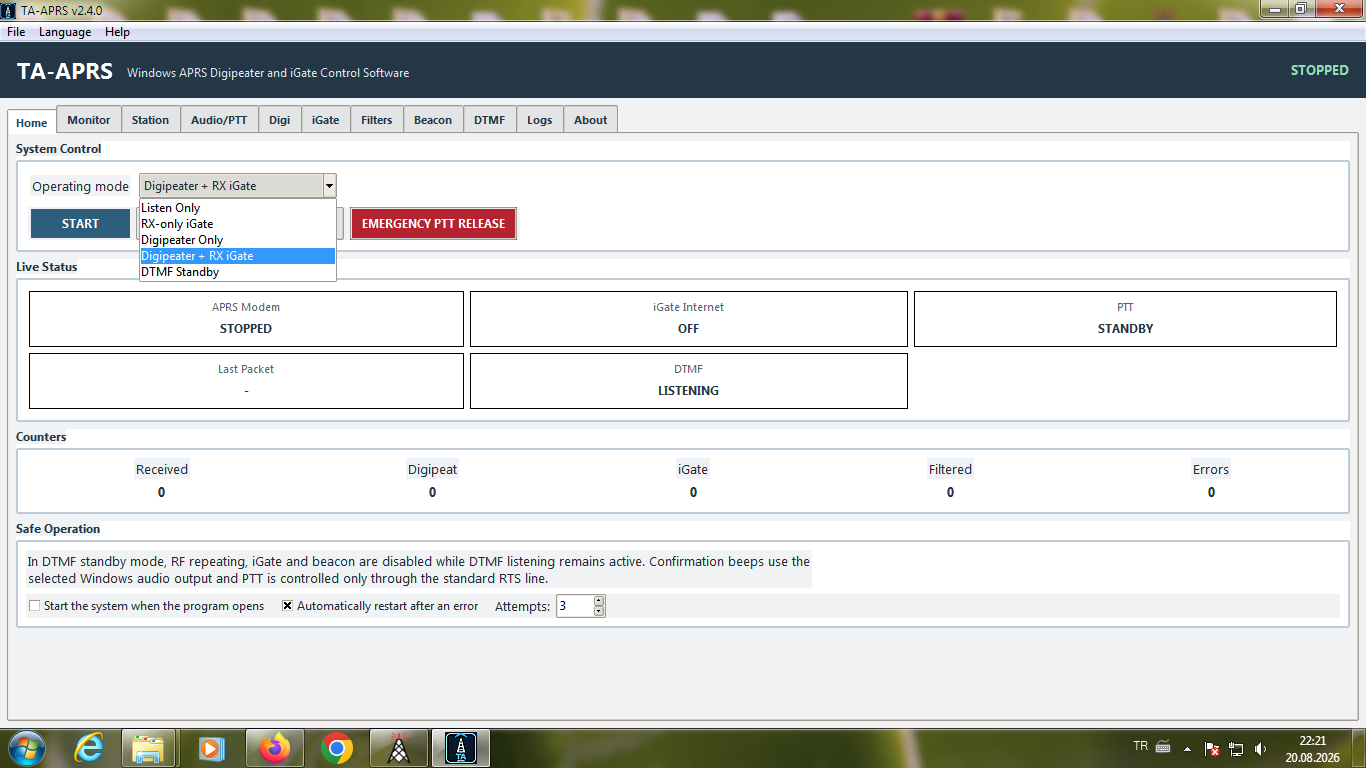
TA-APRS features five selectable operational profiles directly accessible from its main control panel. Operators can switch modes instantly depending on local infrastructure needs and connectivity status:
[System Control: Operating Mode]
 ├── 1. Listen Only           (Passive packet capture & site RF analysis)
 ├── 2. RX-only iGate         (RF to APRS-IS gateway without RF transmit)
 ├── 3. Digipeater Only       (Standalone RF packet relaying without internet)
 ├── 4. Digipeater + RX iGate (Full hybrid: local RF repeating + APRS-IS feed)
 └── 5. DTMF Standby          (RF repeating paused; remote DTMF commands active)
1. Listen Only
In Listen Only mode, the software decodes incoming 1200 baud AFSK AX.25 packets from the soundcard and displays raw packet strings, callsigns, and telemetry in the live monitor. Transmitter PTT and APRS-IS forwarding remain disabled. This mode is ideal for verifying audio levels, testing antenna reception, and performing initial RF coverage surveys.
2. RX-only iGate
This mode ingests packets received on the local RF frequency (such as 144.390 MHz in North America or 144.800 MHz in Europe and Asia) and forwards them upstream to the global APRS-IS server network via TCP port 14580. Because the transmitter never keys, stations can run safely as internet gateways without requiring local frequency coordination or high-duty-cycle radio equipment.
3. Digipeater Only
Designed for off-grid shacks, mountaintops, or field deployments lacking an active internet connection. The software inspects received AX.25 packets, decrements unconsumed hops (such as WIDE1-1 or WIDE2-2), appends its callsign to the path, and retransmits the packet over RF via serial PTT.
4. Digipeater + RX iGate
The complete hybrid profile. The system simultaneously digipeats local RF packets to extend mobile tracker range while injecting those same packets into APRS-IS. Local mobile stations appear instantly on web tracking platforms like aprs.fi while remaining audible to nearby simplex receivers.
5. DTMF Standby
A dedicated maintenance and fail-safe mode. When switched to DTMF Standby, the software halts automatic RF digipeating, outgoing status beacons, and APRS-IS forwarding. However, the background DTMF audio decoder remains active. This allows station trustees to remotely inspect or re-enable the system over the air using dual-tone commands from a handheld radio.
Technical Features and Architecture
TA-APRS includes several practical engineering features tailored for unattended station operation:
+-----------------------------------------------------------------------+
| TA-APRS v2.4.0 Control Dashboard                                      |
+-----------------------------------------------------------------------+
| [Home] [Monitor] [Station] [Audio/PTT] [Digi] [iGate] [Filters]       |
| [Beacon] [DTMF] [Logs] [About]                                        |
+-----------------------------------------------------------------------+
| Operating Mode: [ Digipeater + RX iGate          v ]                  |
| [ START ]   [ EMERGENCY PTT RELEASE ]                                 |
+-----------------------------------------------------------------------+
| Live Status:                                                          |
| APRS Modem: RUNNING      | iGate Internet: CONNECTED  | PTT: STANDBY  |
| Last Packet: 14:02:11    | DTMF: LISTENING            |               |
+-----------------------------------------------------------------------+
| Live Counters:                                                        |
| Received: 1,428  | Digipeat: 312  | iGate: 1,116  | Filtered: 84      |
+-----------------------------------------------------------------------+
| Safe Operation:                                                       |
| [x] Start system when program opens   [x] Auto restart on error (3)   |
+-----------------------------------------------------------------------+
1. Integrated Soundcard AFSK Modem
Rather than relying on virtual audio cables or third-party TNC emulators, TA-APRS incorporates its own 1200 baud Bell 202 AFSK audio engine. Operators select input and output audio endpoints directly from drop-down menus in the Audio/PTT tab. The modem supports standard mark (1200 Hz) and space (2200 Hz) frequency pairs.
2. Hardware PTT Control with Emergency Release
Transmitter keying is managed through serial port handshake lines:
- RTS (Request to Send): Standard pin activation for commercial and DIY radio interfaces.
- DTR (Data Terminal Ready): Alternate pin triggering for specialized CAT and digital interfaces.
- Emergency PTT Release Button: A prominent manual override button on the main dashboard immediately forces the COM port low if a stuck transmitter condition occurs.
- PTT Watchdog: Software-enforced maximum transmit duration prevents continuous carrier transmission during network or audio faults.
3. Over-the-Air DTMF Remote Control
Unattended digipeaters often experience stuck squelch, packet loops, or antenna degradation. TA-APRS includes a built-in DTMF tone recognition engine that listens continuously on the receiver audio channel. Station trustees can:
- Query station health and receive audio confirmation beeps.
- Remotely toggle RF repeating on or off.
- Switch the station between active digipeating, RX iGate, and DTMF Standby.
- Force a software reset or change transmitter parameters using secure DTMF command strings.
4. WIDEn-N Digipeater Engine and Deduplication
The digipeater module adheres to modern APRS routing standards:
- WIDEn-N Support: Supports
WIDE1-n,WIDE2-n, and custom local paths with automated hop decrementing. - Fill-in Digipeating: Can be configured as a low-profile fill-in digipeater responding exclusively to
WIDE1-1. - Duplicate Packet Filter: Maintains a hash table of recently received frames to prevent relaying identical packets within a configurable time window (typically 30 seconds), eliminating destructive ping-pong loops between adjacent digipeaters.
5. APRS-IS Gating and Filtering
The iGate subsystem connects directly to the global APRS-IS backbone:
- Connects to Tier 2 server clusters (
rotate.aprs2.net,euro.aprs2.net,asia.aprs2.net). - Performs callsign validation and APRS-IS passcode verification.
- Provides fine-grained filtering to control which packet types (position, weather telemetry, status messages) are gated to the internet.
6. Real-Time Telemetry Counters and Watchdog Auto-Recovery
The dashboard displays live operational metrics:
- Received: Total raw AX.25 packets decoded over RF.
- Digipeat: Total packets repeated over RF.
- iGate: Total packets forwarded to APRS-IS.
- Filtered: Total duplicate or non-conforming packets rejected.
- Errors: Checksum (FCS) failures and malformed frames.
- Auto Restart: Configurable recovery watchdog that automatically attempts reconnection (e.g., up to 3 attempts) if audio devices or serial ports drop unexpectedly.
Comparison: TA-APRS vs Alternative APRS Solutions
The table below outlines how TA-APRS compares with established APRS software across key operational categories:
| Feature | TA-APRS | Dire Wolf | aprx | UI-View32 | UZ7HO Soundmodem |
|---|---|---|---|---|---|
| Primary OS | Windows (Native GUI) | Linux / Windows (CLI) | Linux (Daemon) | Windows (Legacy GUI) | Windows (Modem only) |
| User Interface | Modern tabbed GUI | Command-line / Console | Text config file | 16-bit Win32 GUI | Basic modem GUI |
| Internal AFSK Modem | Yes (Built-in) | Yes (High-performance) | No (Requires KISS TNC) | No (Requires TNC/Modem) | Yes (Modem only) |
| Built-in Digipeater | Yes (WIDEn-N / Fill-in) | Yes (Advanced rules) | Yes (Advanced rules) | Yes (Basic) | No (Bridge needed) |
| APRS-IS iGate | Yes (Integrated) | Yes (Integrated) | Yes (Integrated) | Yes (Integrated) | No (Bridge needed) |
| DTMF Remote Control | Yes (Native over-the-air) | Via custom scripts | No | No | No |
| Setup Complexity | Low (Turnkey installer) | Moderate to High | Moderate (Linux CLI) | High (Discontinued) | Low (Modem only) |
| Active Maintenance | Active (2026) | Active | Stable / Maintenance | Discontinued (2004) | Periodic updates |
Hardware Interfacing
Deploying TA-APRS requires standard amateur radio digital mode interfacing hardware:
+------------------+          +--------------------+          +--------------------+
|   Windows PC     |          | Hardware Interface |          |   VHF/UHF Radio    |
|                  |          |                    |          |                    |
| Audio Out (Spkr) +=========>| Line In / Attenuator+=========>| Mic / Data In      |
| Audio In (Mic)   |<=========| Line Out / Buffer  |<=========| Speaker / Disc Out | | USB Serial COM +--------->| Optocoupler / RTS  +--------->| PTT Pin            |
+------------------+          +--------------------+          +--------------------+
Supported Hardware Interfaces
- Commercial Soundcard Interfaces: Works directly with devices like the Digirig Mobile, TigerTronics SignaLink USB, and Masters Communications DRA Series.
- Generic USB Soundcards & Serial Adapters: An inexpensive USB CM108 soundcard paired with a CP2102 or CH340 USB-to-UART module provides clean audio and RTS PTT switching through a simple transistor or optocoupler circuit.
- Dedicated Data Port Radios: Transceivers with mini-DIN 6-pin data jacks (such as the Yaesu FTM series, Icom IC-2730, or Kenwood TM-V71A) supply discriminator audio that bypasses receiver de-emphasis, ensuring optimal packet decode rates.
Frequently Asked Questions
What operating systems does TA-APRS support?
TA-APRS is built specifically for Microsoft Windows (Windows 10, Windows 11, and Windows Server editions).
Does TA-APRS require a hardware TNC?
No. TA-APRS includes a built-in software soundcard modem that decodes and encodes 1200 baud Bell 202 AFSK audio directly using your computer soundcard.
Can TA-APRS run without an internet connection?
Yes. When set to Digipeater Only mode, TA-APRS functions as a completely standalone RF packet repeater for off-grid, portable, or mountaintop sites.
What is the purpose of the DTMF Standby mode?
DTMF Standby pauses all RF transmissions and internet gating while keeping the audio decoder active, allowing trustees to send over-the-air commands from a handheld radio.
Who develops TA-APRS?
TA-APRS is developed by Turkish amateur radio operators Erdem Cengiz (TA2AEC) and Abidin Çakır (TA3JO).
Sources and Further Reading
- TA-APRS GitHub Repository
- APRS Protocol Specification (APRS 1.01)
- APRS-IS Core Network Architecture
- Automatic Packet Reporting System Overview
- Live Global APRS Map (aprs.fi)
73 de 9M2PJU

Post Comment