Victorinox Straight Pin A.3645: The Hidden Tool Every Swiss Army Knife Should Carry
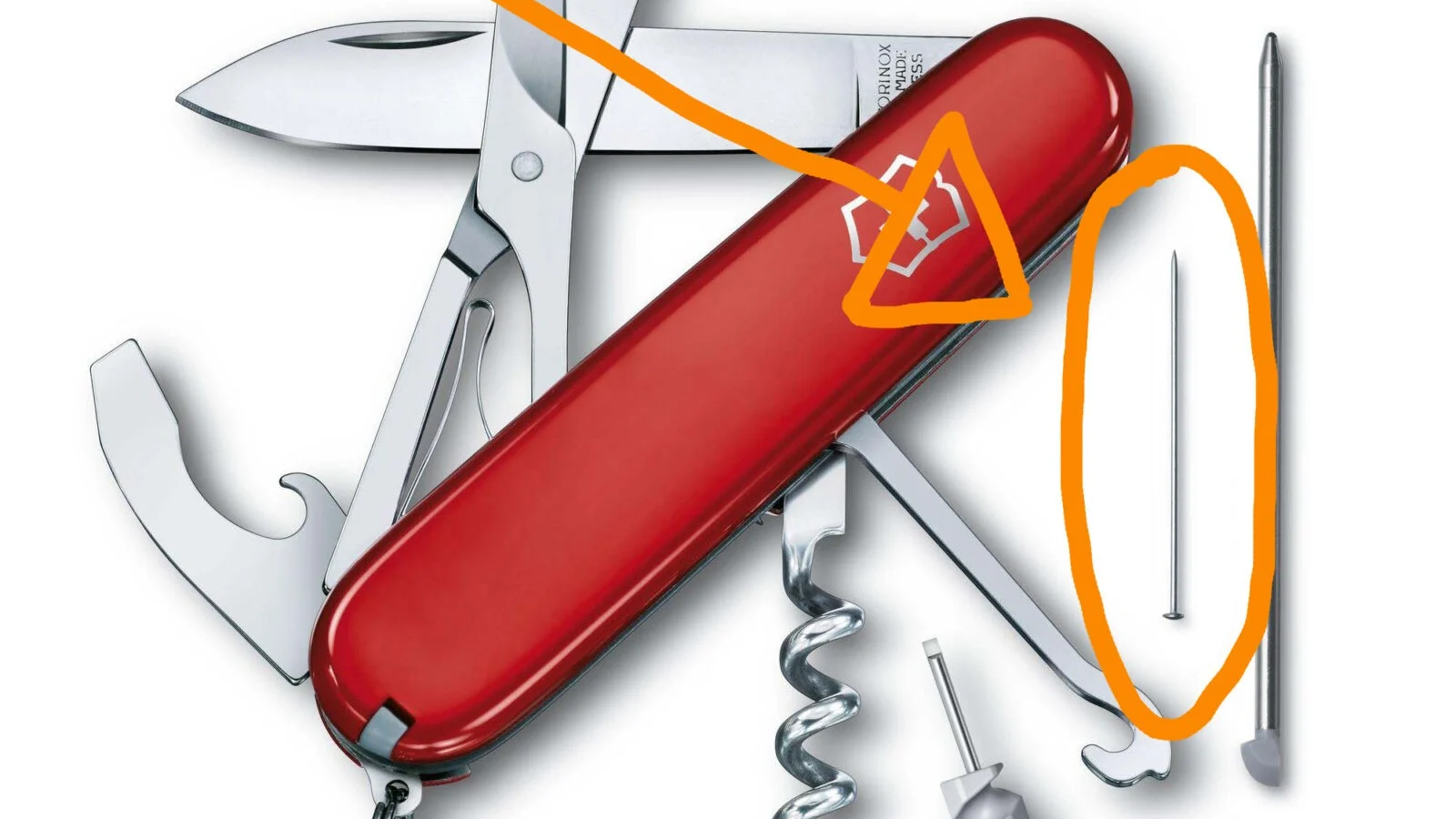
Tucked into the scales of many Swiss Army Knives, behind the corkscrew where almost nobody looks, sits a stainless steel straight pin about as long as a matchstick. Most owners never notice it until the day a splinter goes in and the tweezers can’t get a grip. That pin, Victorinox part A.3645, is the smallest upgrade in the entire Swiss Army system, and this post explains what it is, which knives take it, and why it earns its slot through daily life, outdoor work, and electronics repair.
TL;DR: The Victorinox A.3645 straight pin is a stainless pin that slides into a hidden slot in 91 mm and 111 mm Swiss Army Knife scales and SwissCards. It lifts splinters for the tweezers to grab, presses recessed reset buttons, ejects SIM trays, clears ports and nozzles, and handles dozens of poke-and-prod jobs at zero weight. Check for the slot behind the corkscrew or Phillips, buy the part, keep it clean, and it will save a trip, a hike, or a repair day.
What the A.3645 Straight Pin Is
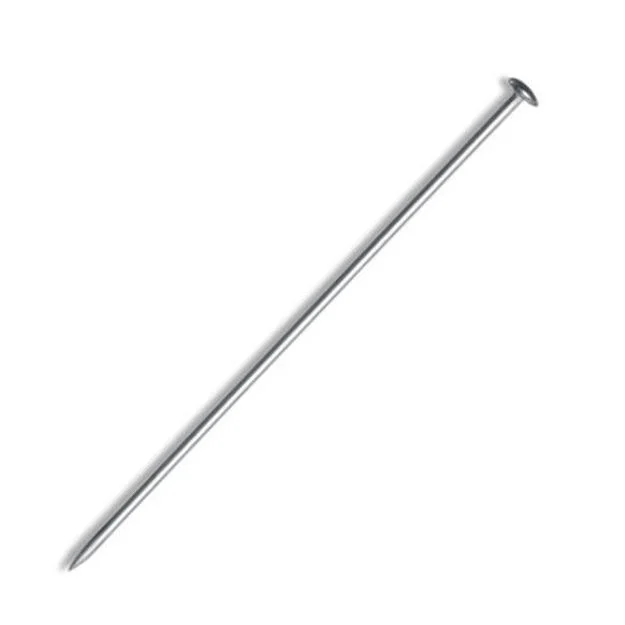
The Victorinox A.3645 straight pin is a stainless steel replacement pin that slides into a dedicated hidden hole in the scales of 91 mm and 111 mm Swiss Army Knives and SwissCards, where it waits as a splinter probe, reset pusher, and general fine-point poker. It has no eye like a sewing needle, no handle, no moving parts. Its entire design is a point on one end, a tiny head on the other, and dimensions exact enough to friction-fit a slot most owners don’t know exists.
Where It Lives and Which Knives Take It
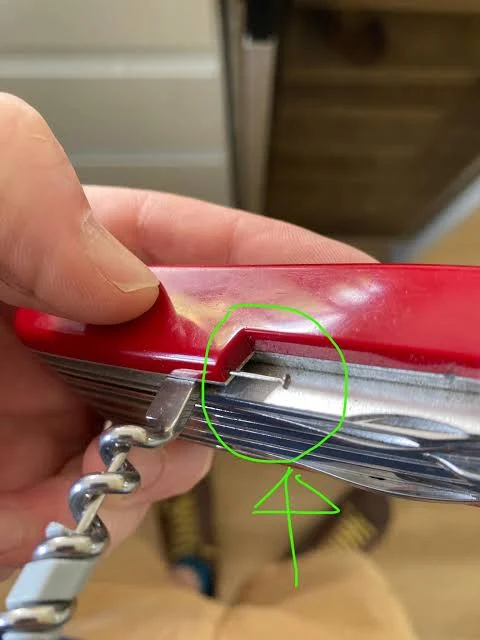
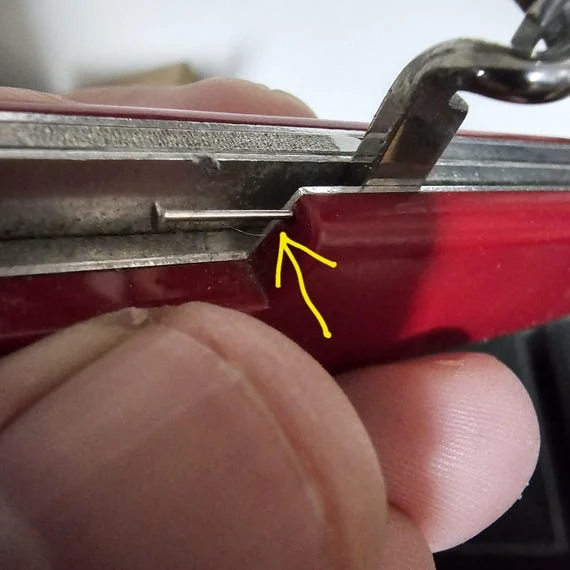
The slot sits in the back scale, in the channel behind the corkscrew on corkscrew models or behind the Phillips screwdriver on Phillips models. Open the corkscrew halfway and look into the scale edge: the pin head glints in its little tunnel. It pulls out with a fingernail and pushes back with a clickless friction fit.
Models that ship with the pinhole include the Compact, Huntsman Lite, Traveller family, and most 91 mm and 111 mm knives with a backside corkscrew or Phillips, plus SwissCards built with the slot. If your knife has neither backside tool, there is nowhere for the pin to live, so check before ordering. One practical warning from the owner community: ordinary dressmaker pins are the right length but too thick for the tunnel. The A.3645 (also listed as 30483 by some dealers) is sized for it. Buy the correctly sized part rather than trimming a sewing pin and hoping.
Daily Life: Splinters, Buttons, and Small Rescues
The headline job is splinter removal, and it is a two-tool procedure. Wood sliver, thorn tip, glass fleck, or metal whisker under the skin: the pin tip lifts and exposes the end, the SAK tweezers grip and draw it. Either tool alone struggles; together they are a pocket first-aid kit that weighs nothing and never needs batteries. Clean the pin with alcohol or a flame pass first, work in good light, and the job that ruins an afternoon takes a minute.
Around the house and desk the list grows fast:
- Pressing recessed reset and WPS buttons on routers, modems, hotspots, and repeaters
- Ejecting SIM and microSD trays on phones, hotspots, and trackers
- Clearing lint from USB-C ports and headphone jacks (device powered off, gently)
- Unclogging glue nozzles, oil cans, and syringe tips
- Opening taped boxes and blister packs without dulling the main blade
- Cleaning under fingernails and around watch lugs in the field
- Marking measurements on wood or soft material where a pencil won’t bite
- Resetting combination locks, kitchen timers, and thermostat pinholes
Outdoor Uses: Trail, Camp, and Field Day
Outdoor, the pin earns its keep exactly where the kit is lightest. Hiking and camping produce splinters, thorns, and cactus spines constantly, and the pin-plus-tweezers method works sitting on a log with no other gear. Bee stingers scrape out with the pin edge. Blisters lance cleanly after sterilizing the tip. A tent zipper jammed with grit picks clear. A stove jet clogged with soot reams out with the point. Guyline knots too tight for cold fingers tease apart with a steel point that doesn’t care about the temperature.
For radio field work the crossover is direct: SOTA and POTA activators already carry a SAK, and the pin resets a frozen hotspot or tracker, ejects the SIM when swapping carriers at a summit, clears a speaker-mic jack full of trail dust, and aligns a connector keyway before mating in poor light. It lives in the knife, so it is there when the separate toolkit is back at the car.
Electronics Repair: the Third Hand You Already Carry
On the electronics bench the pin covers the jobs too small for screwdrivers and too dirty for fingers, with one standing rule: power off first, and never confuse a steel pin with an insulated probe.
- Holding reset while applying power on routers, development boards, and handheld radios
- Ejecting SIM trays on phones, hotspots, and cellular gateways
- Lifting connector latches and aligning FPC ribbons before seating
- Clearing solder-mask crumbs and flux flakes from vias and pads (cold board, light touch)
- Unclogging 3D printer nozzles when cold, and picking strings from prints
- Reaming out blocked vents, microphone holes, and buzzer ports
- Fishing dropped screws from tight chassis corners by dragging, not prying
- Marking drill points on enclosures and scoring cut lines on soft plastics
Two cautions belong here because they bite beginners. Steel conducts, so keep the pin away from live circuits and charged capacitors; it’s a mechanical poker, not a test probe, and it has no business bridging contacts to see what happens. And a pin used on skin stays on skin duty: keep one pin for first aid and, if you are thorough, a second for the bench, because bench grime and blood don’t mix.
Pin Versus the Alternatives
| Job | Straight pin | SAK tweezers | Toothpick | SIM eject tool | Sewing needle |
|---|---|---|---|---|---|
| Lift a splinter end | Best, fine rigid point | Poor alone, grips only | Splinters itself, too soft | Too blunt and short | Good, but eye snags and length varies |
| Pull the splinter | Poor, no grip | Best with pin assist | Poor | No | Poor |
| Reset buttons | Best, exact diameter | No | Breaks off inside | Good, if you have it | Good, fragile |
| SIM eject | Good in a pinch | No | No | Best, purpose built | Bends |
| Always with you | Yes, lives in the scales | Yes, same knife | Only if packed | Only if remembered | Only if packed |
| Electronics poke | Good, rigid steel | No | Static and snap risk | Too short | Too flexible |
| Fits the SAK slot | Yes, A.3645 | N/A, own slot | No | No | Usually too thick |
The takeaway is pairing, not rivalry. The toothpick in the other scale handles teeth and cleaning; the tweezers handle gripping; the pin handles everything needing a fine rigid point. Owners who carry all three scale tools have the complete micro kit.
Buying, Fitting, and Keeping It
The part is available from Victorinox dealers and SAK parts specialists, sometimes listed as 30483. You can order the A.3645 pin here: Buy the Victorinox A.3645 straight pin on AliExpress. Order two: one for the knife, one for the parts drawer, because a pin this small will eventually roll off a bench into another dimension. Fitment is push-in by hand. If it slides too freely, the slot is worn or dirty, and a wipe usually restores the friction. Stainless means no rust in normal carry, but wipe it after first-aid use and sterilize before the next one. SwissCard owners: check your card generation for the pinhole before ordering, since not every card has it.
Honest Limits
- It isn’t a needle: no eye, so no sewing, and no thread tricks.
- It isn’t an awl: the point is fine and will bend or snap under use. Poke and lift, never pry.
- It is tiny and losable: develop the habit of returning it to the slot immediately, the way you close a blade.
- One pin, one duty: skin pin and bench pin should be different pins.
- Hygiene matters: sterilize before skin contact, and don’t share a skin pin the way you wouldn’t share a needle.
- It won’t fix a missing slot: knives without the backside tool have nowhere to store it, and forcing it elsewhere just loses it faster.
Why Every SAK User Should Have One
Because it converts the knife from a cutting tool into a complete micro repair kit at no extra bulk. The blade cuts, the tweezers grip, the toothpick cleans, and the pin reaches everything smaller than all three. Zero weight, zero bulk, zero maintenance, always present because it lives inside the tool you already carry. Check your scales tonight: if the little tunnel behind the corkscrew is empty, that is the simplest upgrade your Swiss Army Knife will ever get.
Sources and Further Reading
- Buy the Victorinox A.3645 straight pin on AliExpress – Ordering link for the pin covered in this guide.
- Victorinox straight pin on SAKWiki – Community reference on splinter and reset-switch uses.
- Straight pin size discussion on r/victorinox – Why standard dressmaker pins are too thick for the slot.
- Which knives have a pin slot on SlashGear – Models shipping with the straight pin.
- CountryKnives Victorinox 30483 straight pin – Alternate part listing and pricing reference.
- SmartKnives straight pin notes – Splinter removal with tweezers as the core use.
73 de 9M2PJU.