amateur radio
General Interest
Technology
11175 kHz, 11175 kHz USB, aircraft alerts, COMMUNITY copy, Copy it yourself, corrections board, Daniel Frenkel, E-4B, E-6B, EAM, EAM monitor, HFGCS, Iceland receiver, KPH, live copy, Missileer device, missileer.watch, shortwave, swl, Valar Systems
9M2PJU
0 Comments
Missileer.watch Three Weeks On: Live Copy-Along, Corrections Board, and a Coming Device
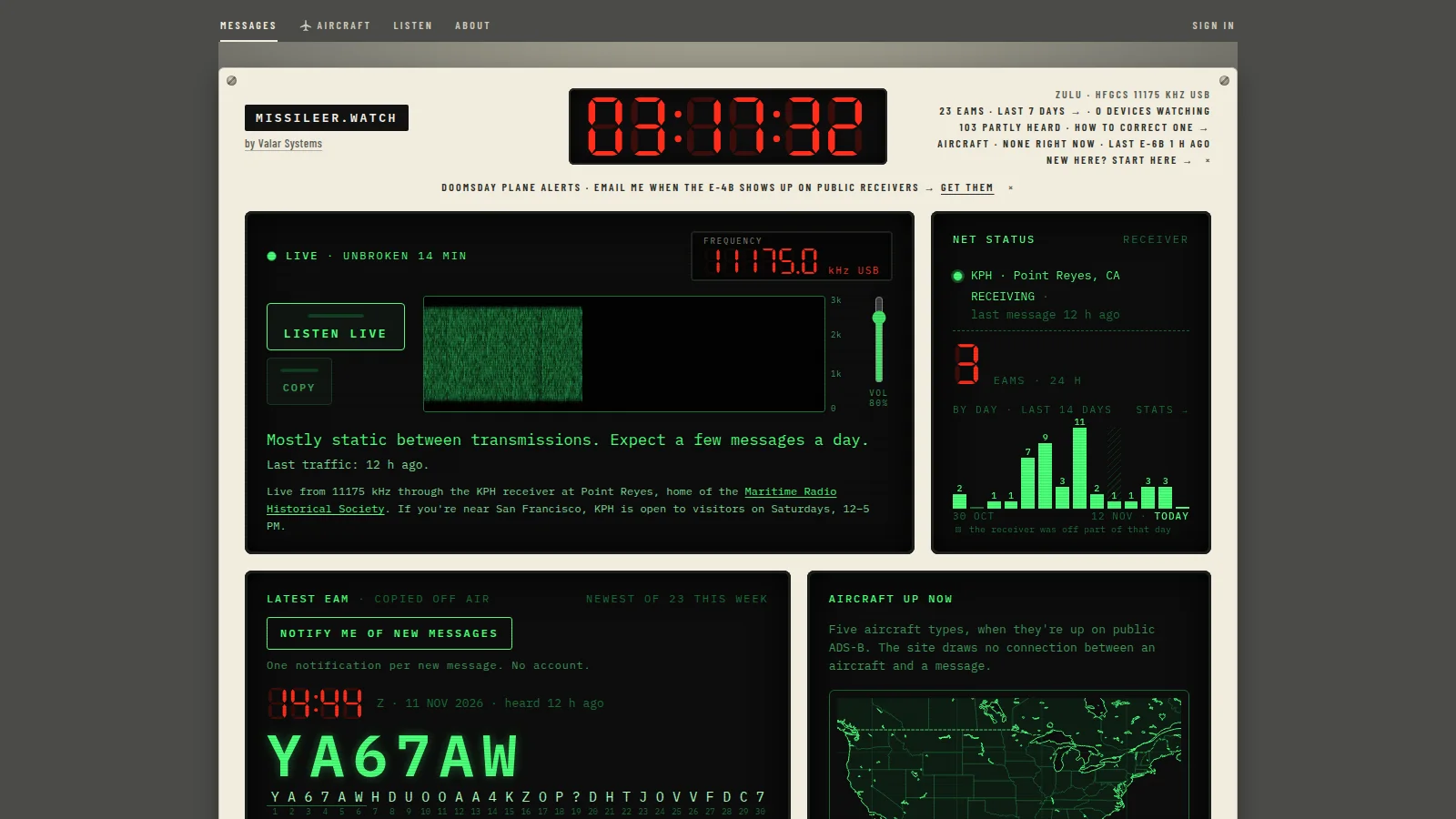
Three weeks after launch, missileer.watch has grown from a listen-only monitor into a place where listeners copy live traffic shoulder to shoulder with the station, fix its transcripts character by character, and rank on a public corrections board. The KPH receiver is still copying around the clock, a hardware device is officially on the way, and every number on the site is still public data you can check yourself.
This is a follow-up to the launch tour in Missileer.watch: Live HFGCS EAM Monitor on 11175 kHz. That post covers the basics: what HFGCS is, who built the site, and how to hear 11175 kHz on your own rig. Read it first if the names on this page are new. This post covers what changed and what to do with it: the live copy pad, the corrections board, the aircraft page upgrades, the coming device, and the Iceland outage.
TL;DR: Missileer.watch now lets signed-in listeners copy EAMs live with SEND COPY, keep a personal log, earn COMMUNITY characters through peer agreement, and rank on the opt-in corrections board. KPH Point Reyes is receiving with 10.5 minute median archive latency, Iceland has been dark since 26 Oct, a hidden device binder and device-news emails point to a coming Missileer device, and all recordings stay CC0 public domain. Start with Copy it yourself, then correct one character.
What This Follow-Up Covers
This follow-up covers the participatory side of the Missileer.watch corrections board era: the live copy-along pad, the peer-agreement system that turns listener copies into published COMMUNITY characters, the opt-in corrections board, the upgraded aircraft page, the coming hardware device, and the current receiver picture. It assumes you already know the site streams USAF HFGCS Emergency Action Messages on 11175 kHz USB. If not, the launch post gets you there in ten minutes.
By the Numbers on 12 November
The site publishes its own metrics as open JSON at data.missileer.watch, so none of this is guesswork. Figures below are from the morning of 12 Nov 2026 UTC.
- 23 EAMs copied in the last seven days, 3 in the last 24 hours, 103 more graded unconfirmed (real traffic the station couldn’t name)
- 6,947 voice recordings transcribed since recording began on 21 Sep 2026
- Archive latency of 10.5 minutes median and 13.3 minutes at the 90th percentile, measured over the last 113 messages across 30 days
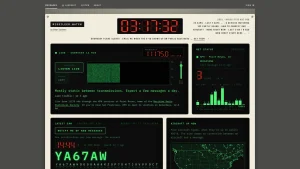
- Latest message YA67AW heard on KPH at 14:44Z on 11 Nov, about 12 hours before this screenshot
- KPH Point Reyes receiving live with fresh audio under a minute old; the Iceland receiver has delivered no audio since 26 Oct and last heard traffic on 24 Oct
- November corrections board led by listener-5ae2 with 13 agreed corrections, then listener-9117 and listener-9cd2 on 10 each
Two honest readings fall out of those numbers. First, the net is quiet in exactly the way the site keeps telling you is normal: a few messages a day, long stretches of static, last traffic half a day ago. Second, the pipeline is fast for a one-person station: voice on air to archived copy in about ten minutes, with the slow tail at thirteen.
Copy It Yourself: the Copy-Along Pad
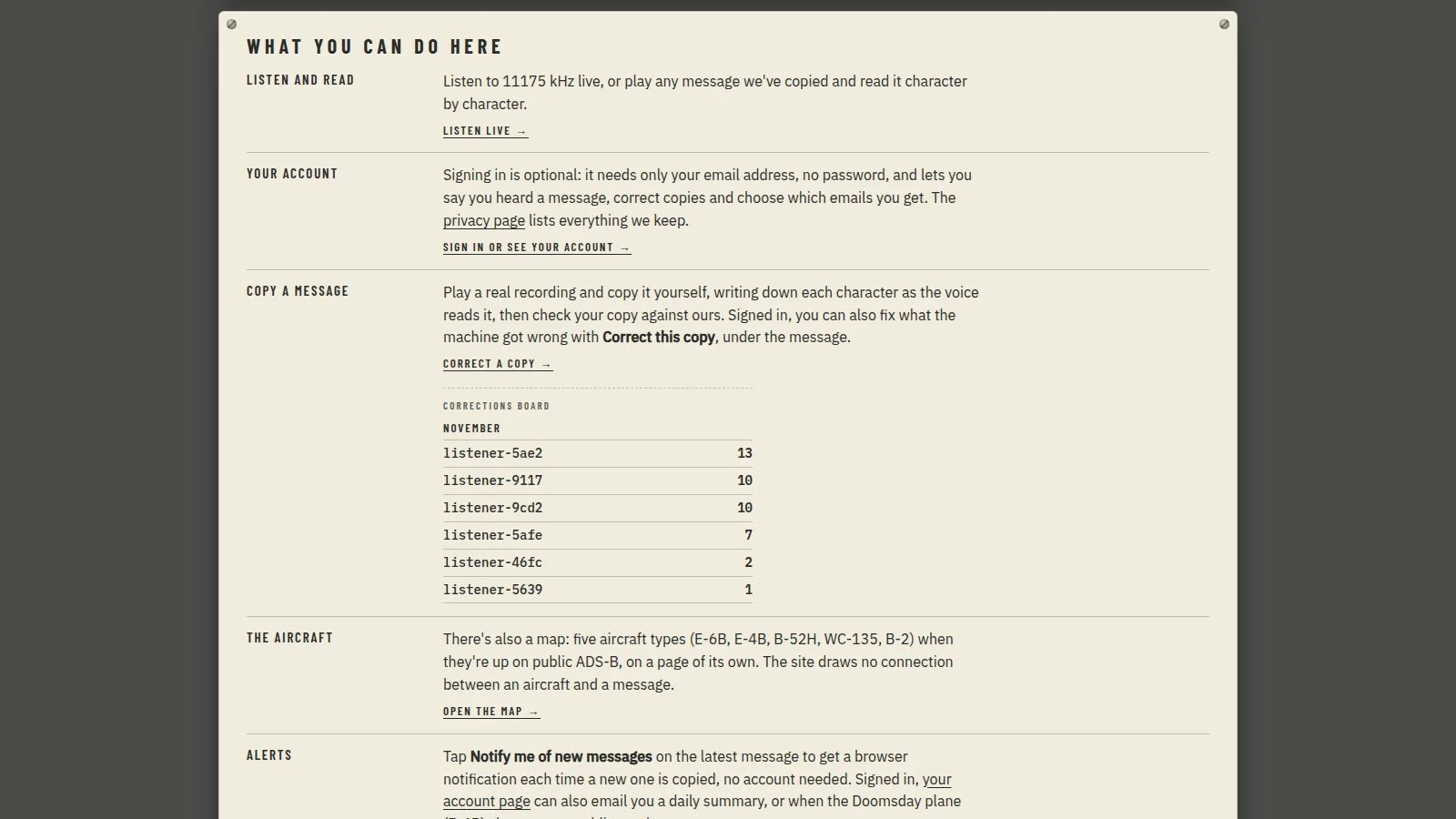
The biggest new toy since launch is the Copy it yourself pad in the Message binder and under LISTEN LIVE. It plays a real recording and lets you write down each character as the voice reads it, then scores your copy against the station copy. Type or tap characters, skip the digits that never appear in traffic (no 0, 1, 8 or 9), mark unknowns with a question mark, and check when done.
Signed in, the pad goes further with SEND COPY during live readings. Your copy of the live reading is kept, and once you have sent one you see the watch copy: at each character, what most listeners typed, shown only where at least two listeners on different networks agreed. Nobody sees your copy. If the live reading becomes a published message, your copy counts as one listener toward its COMMUNITY characters.
Your log ties it together. Press KEEP THIS COPY under a score, or tick the log option on your account page, and the site keeps each practice and live copy with its score and time, plus your time on watch and how many comms checks you answered. Only you see it, on your account page. DELETE MY LOG wipes it at once, and deleting your account wipes it with everything else.
For hams used to CW practice tools, the feel is familiar: VBand-style instant checking applied to spooky voice traffic, with the twist that your practice can graduate into the published record.
The Corrections Board and COMMUNITY Characters
Corrections are where listeners do permanent work. Under any message, Correct this copy lets you fix characters where the machine transcription lost to HF fading and multipath. Your corrected copy shows only to you at first. A changed character goes public marked COMMUNITY once enough other listeners hear the same: listeners on accounts at least 7 days old, on other networks, with corrections spaced at least 6 hours apart. Where listeners disagree, the station character stays and is marked disputed. Corrections that the crowd agrees on stay even in the archive, the device data, and the RSS feed.
The corrections board is the opt-in leaderboard for that work, drawn in the front page guide. It shows the top 10 listeners who turned on the board, each by anonymous handle (listener-5ae2 style, never a nickname or email), with this month agreed-correction count. November leaders at capture time: 13, 10, 10, 7, 2, 1. While fewer than three listeners qualify, last month top three fill the gap.
Abuse controls are strict and public: network fingerprints are keyed hashes of truncated addresses, never raw addresses, deleted after 30 days. Failed checks are never saved, only counted. Accounts that game the count stop counting toward others, then get blocked. If your account is blocked, your live corrections roll back.
Comms Checks and the Unbroken Watch
While LISTEN LIVE plays, the site runs comms checks: the page asks the room to answer, and you tap LOUD AND CLEAR. Checks are counted per network so one listener with five tabs can’t stuff them. The front page tracks the unbroken watch: when the current watch began, when someone was last on watch, how long audio was offline during it, and the longest watch on record. The capture shows LIVE UNBROKEN 14 MIN with 0 devices watching at that instant.
This is the site at its most radio-club: a scheduled net ritual (can you hear me, answer up) rebuilt for browser listeners across time zones, with the attendance book kept in aggregate and nothing about any individual retained.
The Aircraft Page Grows Up
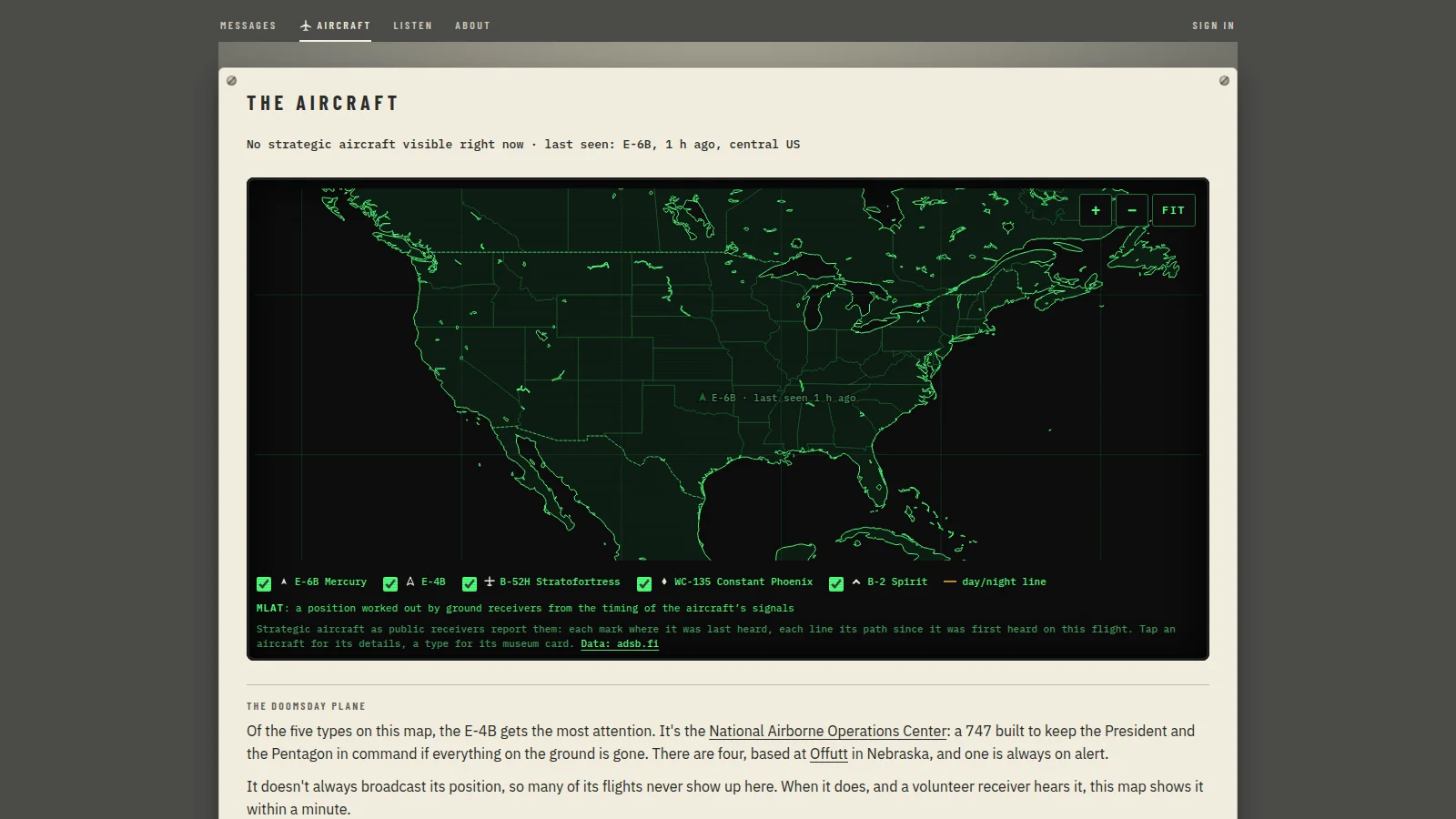
The aircraft page now carries real editorial weight. The map draws five types on public ADS-B (E-6B Mercury, E-4B Nightwatch, B-52H, WC-135, B-2) as last-heard marks with flight paths, within about a minute of a volunteer receiver hearing them. At capture an E-6B seen an hour earlier over the central US was the freshest mark. Type rows toggle, MLAT positions are labeled as such, and tapping a type opens its museum card: the E-6B card links straight from the new Submarines binder, which explains the TACAMO mission.
Below the map, the E-4B section reads like a calm briefing: the National Airborne Operations Center, four 747s at Offutt with one always on alert, flights often invisible because the jet doesn’t always broadcast, and the standing rule that the map shows an aircraft within a minute when a receiver does hear it. The front page still draws no connection between any aircraft and any message, and the email rules enforce the same calm: one email per type after 6 quiet hours, max 10 per UTC day.
A Device Is Coming
The most newsworthy line on the site isn’t on any visible page. The public content files include a binder called The device, currently flagged hidden until the device is ready, and the privacy page (updated today, 12 Nov 2026) offers device news emails: tick the box and you hear about the Missileer device launch and site news. The box comes pre-ticked only for US visitors; everywhere else starts unticked, and no device emails have gone out yet.
No specs, no price, no date. What the scaffolding suggests is a receive-side gadget in the site idiom: plausibly a prebuilt listener that feeds the same copy pipeline, given the front page already counts devices watching (0 at capture) and the stats schema tracks receivers by ID. Malaysia and Asia listeners should leave the box unticked-by-default as it comes and wait for the announcement like everyone else. I’ll cover the device properly when it lands.
Iceland Went Dark
The honest bad news: Iceland is out. The Iceland receiver delivered its last audio on 26 Oct and last heard traffic on 24 Oct. The site copy now reads our receivers copy instead of naming both, and a mid-October ruling notes Iceland out explicitly. KPH carries the whole load: live, receiving, newest segment under a minute old at capture.
For listeners this changes tactics, not value. One receiver means traffic beamed away from California is missed, and your own receiver matters more. In Malaysia that means your own rig or a KiwiSDR on a quiet western US or Pacific path during your evening, comparing fades against KPH, and treating unconfirmed rows (103 and counting) as the interesting edge: real EAMs the station couldn’t name, where one good listener copy can promote a row into the confirmed archive.
Ways to Take Part Compared
| Way to take part | Account needed | What you do | What others see |
|---|---|---|---|
| Listen and read | None | LISTEN LIVE, read copies, watch the board | Your tab counted anonymously in listener totals |
| New message alerts | None | NOTIFY ME OF NEW MESSAGES for browser push | Nothing, subscription stays in your browser |
| Copy it yourself | None to practice, sign-in to keep | Copy a recording, check against station copy | Nothing unless you send corrections |
| SEND COPY live | Sign in | Copy a live reading as it airs | The watch consensus where two networks agree, never your copy |
| Correct this copy | Sign in | Fix mistranscribed characters | Only counts at first, then COMMUNITY characters on agreement |
| Corrections board | Sign in plus opt-in | Let your agreed corrections rank you | Anonymous handle and monthly count in the top 10 |
| Daily summary email | Sign in plus opt-in | One email at 13:00 UTC on days with traffic | Nothing public |
| Aircraft emails | Sign in plus opt-in | Pick E-4B, E-6B, B-52H, WC-135, B-2 types | Nothing public |
The table is a ladder, not a ranking. Lurking with push alerts is a complete way to use the site. Each rung up trades a little identity (an email, a handle on a board) for a little more participation in the shared record.
Five Minutes to Your First Contribution
- Open the launch post archive link for the current latest message and play its recording once through untouched.
- Open Copy it yourself on the same message, copy it cold, and check your score. Note which characters fooled you: fades eat the same consonants every time.
- Sign in with the emailed link, press Correct this copy on that message, and fix exactly one character you’re sure of. Save and confirm your correction shows to you.
- Tick the daily summary on your account page so tomorrow traffic finds you at 13:00 UTC.
- Put 11175 kHz USB in a KiwiSDR or your own rig during your evening, and log the next EAM by hand. Compare your paper copy with the site grid when it archives about ten minutes later.
Why the Follow-Up Matters
Launch coverage answers what a thing is. Three weeks of operation answers whether it works and who it is for. The numbers say the station copies steadily at ten-minute latency with one receiver down. The board says a handful of listeners already do the verification labor in public. The privacy page says the operator thinks about retention windows, keyed hashes, and deletion paths harder than most ham sites think about anything. And the hidden binder says there is more to come.
Shortwave keeps proving it can’t be switched off, and missileer.watch keeps proving that careful listening scales: one receiver, a transcriber, a crowd of copyists, and a veteran explaining the chairs and keys behind the voices. Copy one character and you are part of the record.
Sources and Further Reading
- Missileer.watch live monitor – Live 11175 kHz USB player, latest EAM, net status, guide binders and copy pad.
- Missileer.watch aircraft page – Five tracked types on public ADS-B with museum cards and email alerts.
- Missileer.watch privacy page – Accounts, corrections, logs, retention windows and deletion, updated 12 Nov 2026.
- Missileer.watch sources page – Every citation grouped by binder, HAER sheets, FOIA history and fact sheets.
- Missileer.watch public status data – Message counts, receiver health, latency figures and live state.
- Missileer.watch public stats data – Per-hour and per-day copy counts for 90 days and 365 days, CC0.
- Missileer.watch public archive data – The served message archive both the site and devices read.
- Missileer.watch launch tour on HamRadio.my – The October post this follow-up builds on.
- Hacker News discussion on Missileer.watch – 145 point launch thread with receiver and copy workflow notes.
- Maritime Radio Historical Society KPH – Home of the KPH Point Reyes receiver site.
- High Frequency Global Communications System overview – Frequencies, net structure and station background.
73 de 9M2PJU.


Post Comment