amateur radio
open source
Technology
9M2PJU, amateur radio, digital signal processing, DSP, eSpeak NG, Frey effect, GNU Radio, hackrf, HackRF One, MBROLA, microwave auditory effect, OpenV2K, pulse modulation, PyQt5, raw IQ, RF engineering, sdr, Sharp and Grove, software defined radio, spectrogram, zero-crossing
9M2PJU
0 Comments
OpenV2K: Open-Source Audio-Driven Pulse-Modulated RF Waveform Generation with Software-Defined Radio
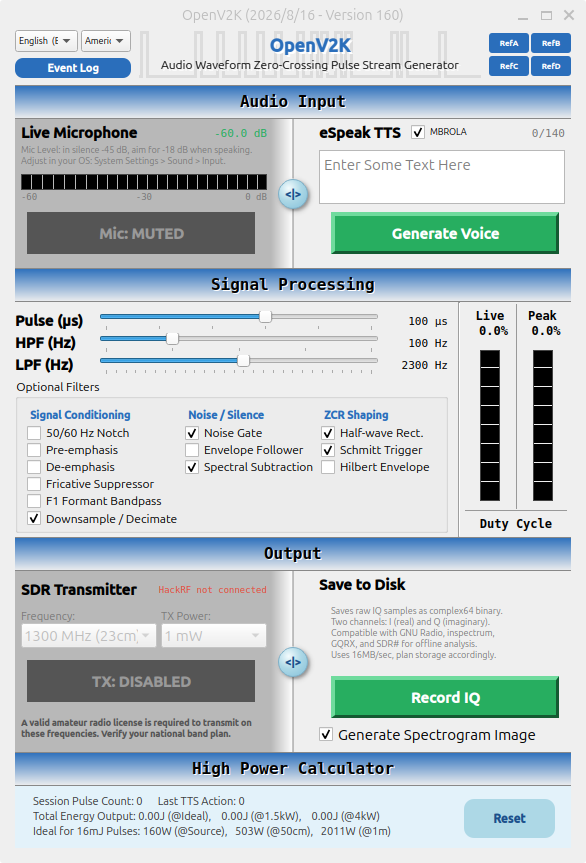
TL;DR: OpenV2K is an open-source Python and GNU Radio application developed by Michael Eby Barr that converts natural speech and synthesized text-to-speech into zero-crossing pulse-modulated radio-frequency (RF) waveforms. Inspired by the 1975 Sharp and Grove microwave auditory effect demonstrations, it provides a transparent software-defined radio (SDR) signal processing testbed, custom DSP filters, raw IQ data capture, real-time duty cycle telemetry, and automated waterfall spectrogram analysis without requiring proprietary laboratory hardware.
Radio frequency modulation is usually associated with continuous carrier manipulation: varying amplitude (AM), shifting frequency (FM), or modulating phase and constellation points in digital modes like PSK, QAM, DMR, and M17. In pulsed RF systems like radar and telemetry, transmissions typically rely on a fixed pulse repetition frequency (PRF) or pulse position modulation (PPM).
In 1975, biophysics researchers Joseph C. Sharp and Mark R. Grove demonstrated a distinct modulation concept at the Walter Reed Army Institute of Research. Instead of using a fixed clock or continuous carrier envelope, they triggered microwave pulses directly at every zero-crossing of a processed speech waveform. This enabled the transmission of intelligible spoken words through pulse-modulated electromagnetic energy.
For decades, the engineering specifics behind this modulation technique remained confined to academic papers, military research archives, and speculative discussions. The OpenV2K project brings this historical signal processing concept into the open-source software-defined radio era. Released into the public domain via the Unlicense on GitHub and documented in the OpenV2K Sandbox, OpenV2K delivers a fully inspectable, multi-stage digital signal processing (DSP) pipeline that transforms human speech into audio-timed RF pulse trains in real time.
What is OpenV2K?
OpenV2K is an open-source Python and GNU Radio application that translates audio waveforms into pulse-modulated radio-frequency signals using zero-crossing digital signal processing and software-defined radio hardware.
+-------------------------------------------------------------------------+
|                        OpenV2K System Architecture                      |
+-------------------------------------------------------------------------+
| [Live Microphone / 48 kHz WAV]    [eSpeak NG / MBROLA TTS (49 Locales)] |
+------------------------------------+------------------------------------+
                                     |
+------------------------------------v------------------------------------+
|               Multi-Stage Audio DSP Conditioning Chain                  |
|  +-------------------+--------------------+--------------------------+  |
|  | DC Blocker / Notch| Pre/De-Emphasis    | Fricative Voicing Detector|  |
|  | (50/60 Hz Biquad) | (Spectral Tilt)    | (Zero-Crossing Rate ZCR) |  |
|  +-------------------+--------------------+--------------------------+  |
|  | F1 Bandpass Filter| Dynamic Noise Gate | Envelope / Hilbert Stage |  |
|  | (300 - 900 Hz)    | (Wiener / Subtr.)  | (Schmitt Trigger / Rect.)|  |
|  +-------------------+--------------------+--------------------------+  |
+------------------------------------+------------------------------------+
                                     |
+------------------------------------v------------------------------------+
|               Zero-Crossing Pulse Generation Engine                     |
|  - Real-Time Zero-Crossing Event Detection                              |
|  - Adjustable Pulse Width (25 us to 150 us)                             |
|  - Segmented Duty-Cycle Telemetry & Average Power Calculation           |
+------------------------------------+------------------------------------+
                                     |
+------------------------------------v------------------------------------+
|               Rational Resampling & RF Baseband Synthesis               |
|  - 48 kHz Audio Rate to 2.0 MHz Complex Baseband                        |
|  - Boxcar (Rectangular) Reconstruction Filter (Preserves Rise Time)     |
+------------------------------------+------------------------------------+
                                     |
                  +------------------+------------------+
                  |                                     |
+-----------------v-----------------+ +-----------------v-----------------+
|   HackRF One SDR Transmitter      | |   Raw Complex64 IQ Binary File    |
|   (Amateur Bands, Milliwatt Level)| |   (GNU Radio, Inspectrum, GQRX)  |
+-----------------------------------+ +-----------------------------------+
Unlike fixed-frequency tone generators or standard voice modulators, OpenV2K acts as a dedicated waveform design and signal analysis laboratory. It couples a graphical user interface written in PyQt5 with custom GNU Radio signal processing blocks (gr.sync_block), letting operators explore how linguistic phonetics, acoustic filtering, and temporal pulse shaping interact at the RF baseband layer.
Historical Context: From the Frey Effect to Sharp and Grove (1975)
Understanding why OpenV2K exists requires examining the historical biophysics literature surrounding pulsed electromagnetic fields.
+-------------------------------------------------------------------------+
|                    Historical Evolution of Pulsed RF Audio              |
+-------------------------------------------------------------------------+
|  1961 - Allan H. Frey discovers the Microwave Auditory Effect (MAE)     |
|  - Radio operators hear pulsed radar transmissions as clicks and chirps |
|  - Mechanism: Thermoelastic expansion within auditory tissues           |
+------------------------------------+------------------------------------+
                                     |
+------------------------------------v------------------------------------+
|  1975 - Joseph C. Sharp & Mark R. Grove (Walter Reed Army Institute)   |
|  - Modulate microwave pulse timing with audio zero-crossing transitions |
|  - Transmission of recognizable spoken numbers without a receiver       |
+------------------------------------+------------------------------------+
                                     |
+------------------------------------v------------------------------------+
|  1990s-2000s - Defense Concepts and Declassified Research               |
|  - US Army "Voice-to-Skull" (V2K) reference terminology                 |
|  - US Navy "MEDUSA" non-lethal acoustic deterrent concepts              |
+------------------------------------+------------------------------------+
                                     |
+------------------------------------v------------------------------------+
|  2026 - OpenV2K: Open-Source Software-Defined Radio Testbed             |
|  - Public domain software-defined signal generation                     |
|  - Transparent DSP verification on GNU Radio and HackRF One             |
+-------------------------------------------------------------------------+
1. The Microwave Auditory Effect (Frey Effect)
In 1961, American neuroscientist Allan H. Frey published observations that human subjects standing within the beam path of pulsed radar transmitters could perceive distinct auditory sensations described as buzzing, clicking, hissing, or chirping. Subsequent biophysical investigations confirmed that this phenomenon, known as the Microwave Auditory Effect (MAE) or the Frey Effect, is caused by rapid thermoelastic expansion.
When an intense, brief microsecond microwave pulse is absorbed by cranial tissue, it causes a minute temperature rise (on the order of 10-6 degrees Celsius). This transient thermal gradient induces a localized acoustic pressure wave that propagates through bone conduction to the inner ear cochlea, where hair cells stimulate the auditory nerve.
2. Sharp and Grove’s 1975 Speech Experiment
While Frey studied individual clicks produced by regular radar pulses, Joseph C. Sharp and Mark R. Grove sought to convey intelligible human speech. In their 1975 experiment at the Walter Reed Army Institute of Research, they recognized that speech intelligibility is heavily concentrated in temporal zero-crossing information.
By processing speech through analog filters and triggering a discrete microwave pulse each time the audio waveform crossed the zero-voltage axis, Sharp and Grove successfully transmitted single-syllable spoken numbers (one through nine) that were intelligible to listening subjects.
3. Declassifications, Defense Lore, and Open Science
In subsequent decades, references to this research appeared in declassified defense documents, including the US Army’s “Voice-to-Skull” (V2K) conceptual studies and the US Navy’s “MEDUSA” (Mob Excess Deterrent Using Silent Audio) non-lethal deterrent proposals. Because the underlying hardware remained classified or proprietary for years, public discussion frequently veered into speculation.
OpenV2K addresses this topic through open science and engineering transparency. By implementing the entire signal transduction pipeline in open-source Python and GNU Radio, it demystifies the mechanics, replaces speculation with measurable DSP code, and gives radio amateurs, signal processing students, and SDR experimenters a practical tool to inspect the waveforms.
Five Disciplines in One Codebase
OpenV2K combines five distinct engineering and scientific disciplines into a single application:
+-------------------------------------------------------------------------+
|                  The Five Disciplines Behind OpenV2K                    |
+-------------------------------------------------------------------------+
| 1. Software Engineering       | 2. Digital Signal Processing (DSP)      |
| - PyQt5 graphical interface   | - Zero-crossing detection algorithms    |
| - Non-blocking audio threads  | - Biquad direct-form DC/notch filters   |
| - XML multi-language engine   | - Spectral subtraction & noise gating   |
+-------------------------------+-----------------------------------------+
| 3. RF & Communications        | 4. Computational Linguistics            |
| - GNU Radio flowgraph engine  | - eSpeak NG formant speech synthesis    |
| - Complex baseband resampling | - MBROLA diphone voice integration      |
| - HackRF One SDR hardware     | - Fricative and formant audio isolation |
+-------------------------------+-----------------------------------------+
| 5. Telemetry & Data Validation|                                         |
| - Real-time duty cycle meters | - Audio-to-RF duration checksums        |
| - Automated IQ spectrograms   | - Complex64 binary IQ export            |
+-------------------------------+-----------------------------------------+- Software Engineering: Built with Python 3 and PyQt5, featuring responsive custom UI controls, threaded audio capture, and full internationalization supporting 49 languages via XML dictionaries.
- Digital Signal Processing (DSP): Features custom GNU Radio sync blocks for direct-form biquad notch filtering, DC blocking, Wiener-style spectral subtraction, and Hilbert transform envelope extraction.
- RF and Communications Engineering: Manages sample rate conversion from 48 kHz audio up to 2.0 MHz complex IQ baseband, driving SDR transmitters or streaming complex binary files to disk.
- Computational Linguistics and Phonetics: Integrates eSpeak NG (formant synthesis) and MBROLA (diphone concatenative synthesis) across international voice banks, with audio pre-processing tailored to speech formants and voicing detection.
- Telemetry and Data Validation: Provides live segmented duty-cycle metering, automated waterfall spectrogram rendering via Matplotlib, and audio-to-RF active duration checksum validation.
The OpenV2K Signal Conditioning & Modulation Pipeline
The core technical contribution of OpenV2K is its audio-to-pulse transduction engine. The application processes audio through several configurable stages before synthesizing the RF pulse train:
+-------------------------------------------------------------------------+
|                     OpenV2K Detailed Signal Flowgraph                   |
+-------------------------------------------------------------------------+
| [Audio Input Source] Live Microphone (48 kHz) or Diphone TTS Engine     |
+------------------------------------+------------------------------------+
                                     |
+------------------------------------v------------------------------------+
| [Stage 1: DC Blocker & Mains Notch]| Custom Direct-Form Biquad Filter   |
|                                    | Strips 50/60 Hz Hum & DC Offset    |
+------------------------------------+------------------------------------+
                                     |
+------------------------------------v------------------------------------+
| [Stage 2: Pre-Emphasis Filter]     | Selectable High-Frequency Boost    |
|                                    | Compensates for Spectral Roll-off  |
+------------------------------------+------------------------------------+
                                     |
+------------------------------------v------------------------------------+
| [Stage 3: Voicing & Fricative Gate]| Zero-Crossing Rate (ZCR) Estimator |
|                                    | Suppresses Unvoiced Hiss / Noise   |
+------------------------------------+------------------------------------+
                                     |
+------------------------------------v------------------------------------+
| [Stage 4: Formant Bandpass (F1)]   | 300 Hz - 900 Hz Bandpass Isolation |
|                                    | Isolates Primary Speech Energy     |
+------------------------------------+------------------------------------+
                                     |
+------------------------------------v------------------------------------+
| [Stage 5: Dynamics & Shaping]      | Noise Gate / Envelope Follower /   |
|                                    | Hilbert Analytic Signal Extraction |
+------------------------------------+------------------------------------+
                                     |
+------------------------------------v------------------------------------+
| [Stage 6: ZeroCrossPulse Block]    | Custom gr.sync_block Detection     |
|                                    | Generates 25 us - 150 us RF Pulses |
+------------------------------------+------------------------------------+
                                     |
+------------------------------------v------------------------------------+
| [Stage 7: Rational Resampler]      | Upsamples 48 kHz to 2.0 MHz IQ     |
|                                    | Boxcar Filter Preserves Fast Edges |
+------------------------------------+------------------------------------+
                                     |
             +-----------------------+-----------------------+
             |                                               |
+------------v------------+                     +------------v------------+
| [HackRF One SDR Sink]   |                     | [Complex64 File Sink]   |
| 2.0 MS/s RF Output      |                     | Raw IQ Binary Capture   |
+-------------------------+                     +-------------------------+
1. DC Blocking and Adaptive Mains Hum Rejection
Live microphone audio often suffers from DC bias and 50 Hz or 60 Hz electrical mains hum. OpenV2K implements a custom direct-form biquad notch filter and DC blocker written directly in Python (DCBlocker subclassing gr.sync_block). This eliminates low-frequency rumble that would otherwise trigger spurious zero-crossing pulses.
2. Pre-Emphasis and Spectral Tilt
Human speech exhibits a natural roll-off of approximately -6 dB per octave across higher frequencies. The pre-emphasis stage boosts higher formant frequencies, ensuring that vowel transitions and upper consonant details have sufficient amplitude to cross the zero-voltage threshold cleanly.
3. Fricative Suppression and Voicing Detection
Unvoiced consonants (such as “s”, “sh”, and “f”) have high-frequency, noise-like waveforms with dense zero-crossings that can cause pulse clustering and elevate the duty cycle. OpenV2K uses a local Zero-Crossing Rate (ZCR) detector to classify voiced versus unvoiced segments, attenuating excessive high-frequency noise bursts while preserving intelligible vowel formants.
4. First-Formant (F1) Bandpass Isolation
To focus pulse generation on core vowel intelligibility, an optional bandpass stage isolates the first speech formant band (approximately 300 Hz to 900 Hz). This reduces background clutter and stabilizes the pulse repetition cadence.
5. Dynamics, Noise Gating, and Hilbert Envelope Shaping
OpenV2K provides selectable conditioning modules:
- SimpleNoiseGate: Attenuates signals below a user-defined decibel threshold (e.g., -30 dB) to keep the transmitter completely silent during speech pauses.
- EnvelopeFollower: Tracks the amplitude envelope with configurable attack and decay time constants.
- HilbertEnvelopeExtractor: Computes the analytic signal envelope, smoothing abrupt phase reversals and stabilizing zero-crossing points.
- HalfWaveRectifier: Passes only positive voltage swings, effectively halving the trigger count for experimental comparison.
6. The ZeroCrossPulse Generator Block
The core custom block, ZeroCrossPulse, monitors the sign of incoming 48 kHz floating-point audio samples. Each time the signal transitions from negative to positive (or crosses zero according to selected hysteresis), the block outputs an active pulse of precisely configurable duration (adjustable from 25 microseconds to 150 microseconds).
7. Rational Resampling and Boxcar Edge Preservation
To interface with standard SDR front ends, the generated 48 kHz pulse stream must be upsampled to a standard baseband rate, such as 2.0 MHz.
Standard interpolation algorithms apply a windowed-sinc reconstruction filter, which rounds pulse transitions and creates pre-ringing artifacts. OpenV2K deliberately employs a boxcar (rectangular) reconstruction filter during rational resampling. This design choice maintains steep pulse rise and fall times, preserving fast transient edges through the RF output stage.
Data Provenance, Validation, and Telemetry
OpenV2K includes built-in verification tools to ensure that generated RF waveforms match the source audio:
+-------------------------------------------------------------------------+
|                  OpenV2K Data Integrity & Telemetry Flow               |
+-------------------------------------------------------------------------+
| [Source Audio Buffer] ----------------------------+                     |
|                                                   |                     |
| [Synthesized RF IQ Stream]                        |                     |
|          |                                        |                     |
|          v                                        v                     |
| [Active Pulse Region Detector]           [Audio Active Detector]        |
|          |                                        |                     |
|          +--------------------+-------------------+                     |
|                               |                                         |
|                               v                                         |
|                 [Duration Checksum Comparator]                          |
|                 - Validates Timing Fidelity                             |
|                 - Logs Results to Event Log                             |
|                 - Renders Matplotlib Spectrogram                        |
+-------------------------------------------------------------------------+
1. Complex64 Raw IQ Recording
OpenV2K can stream raw complex64 baseband IQ data directly to disk. These .raw or .iq files can be opened in external analysis tools:
- Inspectrum: For precise sample-level time and frequency measurements.
- GNU Radio Companion: For custom post-processing and demodulation flowgraphs.
- GQRX / SDR# / SDR Angel: For baseband playback and spectral visualization.
2. Automated Waterfall Spectrogram Generation
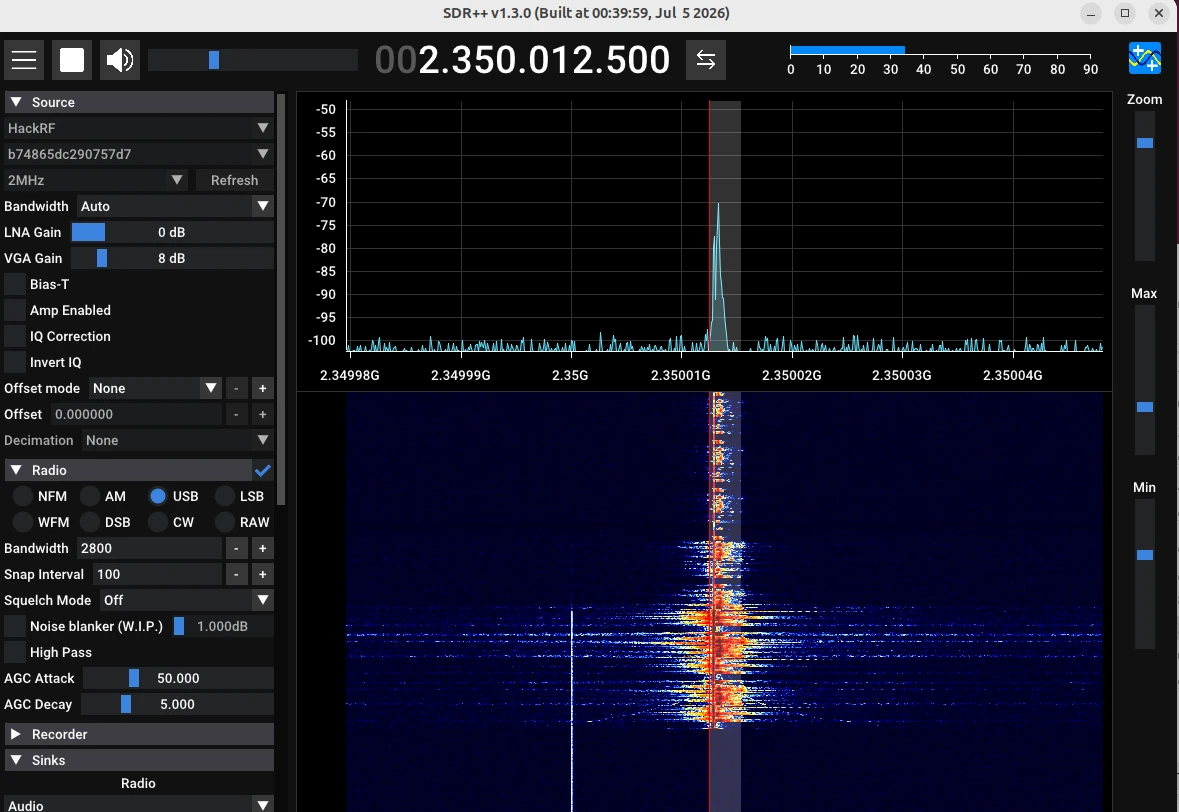
Upon completing an audio transmission or capture run, OpenV2K automatically uses Matplotlib to render high-resolution time-domain and frequency-domain spectrograms. These plots display individual pulse bursts, temporal spacing, and spectral distribution, providing immediate visual feedback on the effect of each DSP filter.
3. Audio-to-RF Duration Checksum Comparator
To verify that no samples were dropped or distorted during resampling, OpenV2K measures the active duration of the input speech and compares it against the detected duration of the RF pulse train. The result is recorded in the application’s runtime event log, providing an audit trail for experimental data.
4. Real-Time Segmented Duty-Cycle Telemetry
Pulsed RF transmissions require careful thermal and power management. OpenV2K features a segmented duty-cycle meter that continuously computes the ratio of active pulse time to total transmission time. This helps operators monitor average transmitter power and ensure compliance with hardware safety limits.
Hardware, Power, and Regulatory Scope
OpenV2K maintains a strict distinction between low-power software-defined radio experimentation and high-power bioeffects exposure systems:
+-------------------------------------------------------------------------+
|                      Hardware and Regulatory Boundaries                 |
+-----------------------------------+-------------------------------------+
| OpenV2K SDR Prototyping (Safe)    | High-Power Bioeffects Facilities    |
+-----------------------------------+-------------------------------------+
| - General-purpose HackRF One SDR  | - Multi-kilowatt pulsed transmitters|
| - Power levels: ~1 mW (0 dBm)     | - Specialized anechoic chambers     |
| - Amateur radio band allocations  | - Calibrated phantom dosimetry      |
| - Waveform & DSP analysis only    | - Institutional safety oversight    |
| - No bioeffects produced/claimed  | - Formal medical / IRB review       |
+-----------------------------------+-------------------------------------+- Low-Power SDR Operation: OpenV2K is designed to interface with the HackRF One, an open-source SDR transceiver capable of operating from 1 MHz to 6 GHz. The HackRF delivers approximately 0 dBm to 10 dBm (1 to 10 milliwatts) of RF output power.
- Amateur Radio Licensing: When transmitting over the air, operators must confine emissions to authorized amateur radio frequency bands (such as 70 cm, 23 cm, or 13 cm microwave allocations) and comply with local callsign identification and power rules.
- Simulation Without Hardware: Users do not need an SDR to explore OpenV2K. The application can run entirely in software, writing IQ samples to disk and rendering spectrograms for study on a standard laptop.
- Waveform Research vs Bioeffects: Reproducing genuine microwave auditory sensations requires peak pulse powers in the kilowatt range, calibrated waveguide feeds, anechoic chambers, and formal safety oversight. OpenV2K does not generate bioeffects; it serves solely as an accessible tool for modeling and analyzing the underlying waveforms.
Technical Comparison: RF Modulation Paradigms
To illustrate how OpenV2K’s zero-crossing pulse modulation compares to other RF transmission methods, consider the following technical matrix:
| Modulation Scheme | Primary Information Carrier | Spectral Characteristics | Typical Applications | Receiver Demodulation Method |
|---|---|---|---|---|
| OpenV2K Pulse Modulation | Speech zero-crossing pulse timing & intervals | Wideband pulsed spectral lines | MAE waveform study, pulse research | Envelope thresholding / pulse interval detection |
| Amplitude Modulation (AM) | Carrier voltage amplitude envelope | Carrier + upper & lower sidebands | Commercial broadcast, aviation VHF | Diode envelope detector / product detector |
| Frequency Modulation (FM) | Instantaneous carrier frequency deviation | Bessel function sidebands | Amateur VHF/UHF, commercial FM | Quadrature detector / phase-locked loop (PLL) |
| Radar Pulsed RF | Fixed pulse repetition frequency (PRF) | Discrete spectral sinc envelope | Target ranging, Doppler velocity | Matched filter / pulse compression delay lines |
| Digital Voice (DMR / Codec 2) | Digitized vocoder bits in 4FSK / QPSK frames | Bandwidth-limited digital channels | Ham radio DMR, M17, P25, D-STAR | Digital baseband demodulator & vocoder decoder |
Step-by-Step Installation and Quick Start Guide
OpenV2K runs on standard Linux distributions, such as Ubuntu 24.04, Ubuntu 26.04, Debian, and Linux Mint.
+-------------------------------------------------------------------------+
|                       OpenV2K Installation Steps                        |
+-------------------------------------------------------------------------+
| Step 1: Install System Packages & GNU Radio                             |
| sudo apt update && sudo apt install gnuradio gr-osmosdr hackrf \        |
|      python3-pyqt5 python3-numpy espeak-ng mbrola mbrola-us1            |
+------------------------------------+------------------------------------+
                                     |
+------------------------------------v------------------------------------+
| Step 2: Install Python Libraries                                        |
| pip3 install matplotlib --break-system-packages                         |
+------------------------------------+------------------------------------+
                                     |
+------------------------------------v------------------------------------+
| Step 3: Clone OpenV2K Sandbox Repository                                |
| git clone https://github.com/OpenV2K/Sandbox.git                        |
+------------------------------------+------------------------------------+
                                     |
+------------------------------------v------------------------------------+
| Step 4: Launch OpenV2K Application                                      |
| cd Sandbox && python3 OpenV2K160.py                                     |
+-------------------------------------------------------------------------+
1. Install System Dependencies
Open a terminal and install GNU Radio, Osmocom SDR drivers, HackRF utilities, PyQt5, and the speech synthesis engines:
sudo apt update
sudo apt install gnuradio gr-osmosdr hackrf python3-pyqt5 python3-numpy espeak-ng mbrola mbrola-us1
2. Install Matplotlib for Spectrogram Plotting
Install Matplotlib to enable automated waterfall spectrogram generation:
pip3 install matplotlib --break-system-packages3. Download the OpenV2K Sandbox
Clone the development repository:
git clone https://github.com/OpenV2K/Sandbox.git
cd Sandbox
Ensure the language dictionary file Translations.xml resides in the same directory as the main script (OpenV2K160.py).
4. Running in File-Only Mode (No SDR Attached)
To evaluate the DSP chain without hardware:
- Launch the application:
python3 OpenV2K160.py - Select your desired language from the upper-left dropdown (e.g., English, Spanish, German, Japanese).
- Type a sentence into the Text-to-Speech input field, or select Live Mic for microphone input.
- Set the RF output destination to Disk (Raw IQ).
- Click Generate / Transmit.
- OpenV2K synthesizes the audio, processes it through the active filter chain, logs duration telemetry, and generates a detailed PNG spectrogram in the working directory.
5. Running with a HackRF One Transceiver
- Connect your HackRF One to a USB 3.0 port and verify detection:
hackrf_info - In the OpenV2K interface, configure your carrier frequency within an authorized amateur band (e.g.,
434.000 MHz). - Set the target pulse width (e.g.,
100 us). - Monitor the live duty-cycle gauge to ensure safe average power levels.
- Transmit into a dummy load or an authorized test antenna for local laboratory analysis.
Frequently Asked Questions (FAQ)
What is OpenV2K?
OpenV2K is an open-source Python and GNU Radio application that converts natural speech or synthesized text-to-speech into zero-crossing pulse-modulated RF waveforms using software-defined radio hardware.
Does OpenV2K require a HackRF SDR to run?
No. OpenV2K runs in software simulation mode on any Linux computer, streaming raw complex64 IQ binary files to disk and generating automated waterfall spectrograms without external RF hardware.
What was the 1975 Sharp and Grove experiment?
Joseph C. Sharp and Mark R. Grove demonstrated at Walter Reed Army Institute that pulsing microwave energy at the zero-crossing points of spoken audio could transmit intelligible voice words via the microwave auditory effect.
Can OpenV2K cause auditory sensations at home?
No. OpenV2K transmits at milliwatt power levels using an SDR for waveform analysis. Producing physical microwave auditory sensations requires specialized multi-kilowatt pulsed transmitters and dedicated laboratory safety controls.
What speech synthesis engines does OpenV2K use?
OpenV2K integrates eSpeak NG for formant synthesis and MBROLA for diphone concatenative synthesis, supporting multi-language voice packs and international GUI localization across 49 languages.
Summary: Open-Source Transparency for Experimental Waveforms
OpenV2K translates a historically complex RF modulation technique into clean, open-source software. By providing an inspectable Python and GNU Radio implementation with comprehensive filtering, real-time telemetry, and raw IQ export, developer Michael Eby Barr has created a practical educational tool for radio amateurs, DSP engineers, and SDR hobbyists.
Whether you are studying speech acoustics, building custom GNU Radio sync blocks, or analyzing pulse-modulated RF in inspectrum, OpenV2K offers an accessible, transparent foundation for laboratory exploration.
73 from 9M2PJU.
Sources and Further Reading
- OpenV2K GitHub Organization – Official source code repository.
- OpenV2K Sandbox Development Repository – Tutorials, flowgraphs, and Python build archives.
- Allan H. Frey (1961): Human Auditory System Response to Modulated Electromagnetic Energy – Foundational research on the Microwave Auditory Effect.
- Joseph C. Sharp and Mark R. Grove (1975): Voice-Modulated Microwave Demonstrations – Historical Walter Reed Army Institute experiments.
- GNU Radio Project – The open-source software development toolkit for SDR systems.
- Great Scott Gadgets HackRF One – Open-source 1 MHz to 6 GHz SDR transceiver hardware.
- eSpeak NG Text-to-Speech Engine – Open-source multi-lingual software speech synthesizer.
- MBROLA Diphone Speech Synthesizer – Concatenative diphone speech database and synthesis engine.


Post Comment